



Carica papaya 'Pusa Nanha' (dwarf papaya)
29,99€ EUR
/
Sold out
Tax included.
Shipping calculated at checkout.
 Carica papaya 'Pusa Nanha' (dwarf papaya)
29,99€ EUR
/
Carica papaya 'Pusa Nanha' (dwarf papaya)
29,99€ EUR
/

Carica papaya 'Pusa Nanha' (dwarf papaya)
29,99€ EUR
/
products.product.pickup_availability.unavailable
Description
Of course, the papaya is primarily known for its delicious fruit, but it is also botanically quite curious and has high ornamental value due to its unusual appearance. Originally from Central America, it is now cultivated worldwide in tropical and subtropical climates.
The variety 'Pusa Nanha' or 'Pusa Dwarf' is a dwarf variety from Indian breeding. It only grows to about 2 meters tall (instead of the usual up to 10 meters) and bears its numerous fruits densely packed on its short trunk.
Papayas are often called papaya trees because of their growth habit, but this is botanically incorrect, as their trunk (and there is always only one trunk per plant) is hollow inside and does not become completely woody. Only the larger tracheids become woody. Therefore, it is neither a tree nor a shrub, but rather a kind of "tree-like herb".
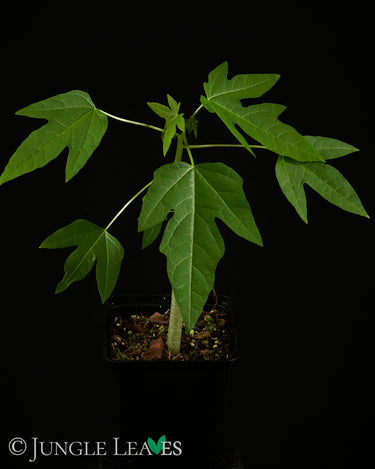
Its leaves are arranged spirally around the trunk. At regular intervals, it sheds its oldest (lowest) leaf. Thus, the leaf spiral shifts upwards in sync with the trunk's growth, and the base of the tree becomes bare. The leaves themselves are quite large (up to about 50 cm) and palmately lobed twice.
The fruit of Carica papaya is botanically a berry and can weigh up to 10 kg! However, most cultivated varieties remain significantly smaller. Papayas sold in our region usually only weigh about 0.5 kg.
To bear fruit in our climate, it needs to be cultivated in a conservatory or greenhouse. The 'Pusa Nanha' variety grows to about 1.5 to 2 meters tall as a container plant and must reach this height before it will bear fruit. If you have the space, however, it's easy to get it to flower and fruit because it grows extremely quickly.
You will receive a strong young plant, approximately 30 to 40cm tall, in a 9cm square pot.
Please note: Papaya plants usually react to changes in location by dropping most of their leaves. However, they quickly sprout new growth and then continue to grow rapidly.
The variety 'Pusa Nanha' or 'Pusa Dwarf' is a dwarf variety from Indian breeding. It only grows to about 2 meters tall (instead of the usual up to 10 meters) and bears its numerous fruits densely packed on its short trunk.
Papayas are often called papaya trees because of their growth habit, but this is botanically incorrect, as their trunk (and there is always only one trunk per plant) is hollow inside and does not become completely woody. Only the larger tracheids become woody. Therefore, it is neither a tree nor a shrub, but rather a kind of "tree-like herb".
Its leaves are arranged spirally around the trunk. At regular intervals, it sheds its oldest (lowest) leaf. Thus, the leaf spiral shifts upwards in sync with the trunk's growth, and the base of the tree becomes bare. The leaves themselves are quite large (up to about 50 cm) and palmately lobed twice.
The fruit of Carica papaya is botanically a berry and can weigh up to 10 kg! However, most cultivated varieties remain significantly smaller. Papayas sold in our region usually only weigh about 0.5 kg.
To bear fruit in our climate, it needs to be cultivated in a conservatory or greenhouse. The 'Pusa Nanha' variety grows to about 1.5 to 2 meters tall as a container plant and must reach this height before it will bear fruit. If you have the space, however, it's easy to get it to flower and fruit because it grows extremely quickly.
You will receive a strong young plant, approximately 30 to 40cm tall, in a 9cm square pot.
Please note: Papaya plants usually react to changes in location by dropping most of their leaves. However, they quickly sprout new growth and then continue to grow rapidly.
Care tips
Light & Location
Substrate & Repotting
Watering & Fertilizing
What makes us at Jungle Leaves special!


Welcome
Bring the Tropic to Your Home
Jungle Leaves is a team of 3 biologists who breed, propagate and sell extraordinary and unique plants from all over the world, also in cooperation with botanical gardens.