

Here you can show and hide plants that are currently in stock.
For plants that are not currently available, you can sign up for an automatic email notification. As soon as the plant is back in stock, you will be notified by email.
Here you can filter plants by price.
Here you can filter plants by their suitability for different environments. Plants can have one or more of these suitabilities:
- Houseplant - Means that this plant is generally suitable for indoor care.
Example: Alocasia wentii. It does not mean that it thrives in every location in the home, or that it will not eventually become too large for a typical living space. Example: Alocasia macrorrhizos.
- Plant Cabinet - Plants with this suitability are usually more sensitive to typical indoor conditions and should therefore be kept in a protected space, which does not have to be as warm and humid and controlled as a proper terrarium. Experienced plant enthusiasts can certainly keep many of these plants as houseplants. Example: Alocasia melo.
This also includes plants that will probably eventually become too large for a plant cabinet. Example: Alocasia nebula.
- Terrarium - Plants with this suitability are those that either do not do well in indoor conditions (Example: Alocasia azlanii), or that remain small enough to be permanently kept in a typical terrarium of 60x40x60cm base area, but could also be kept indoors or in a cabinet. Example: Alocasia scalprum.
This always refers to a tropical terrarium, not a desert terrarium. Succulents are generally given the suitability as a houseplant.
- Bottle Garden - This suitability means that the plant thrives in the mostly stagnant, very humid air in a typical bottle garden and either remains small enough permanently to grow in a bottle garden of approx. 20 cm (Example: Sarcopyramis sp. 'Green Lime'), or that it can be kept small enough by pruning so that it looks good permanently there (Example: Begonia prismatocarpa). All bottle garden plants are also terrarium plants but not vice versa.
- Greenhouse - These plants usually have at least one other suitability (e.g. houseplant) but simply become too large for the living space, cabinet or terrarium and cannot be easily pruned or kept small. Example: Salacca zalacca, Salak palm. Tropical fruit trees also fall into this suitability category. Although they can be kept small by pruning, they will not flower or bear fruit this way.
Plants can have multiple suitabilities. If you select multiple boxes, this filter will only show plants that meet ALL selected boxes.
Example: You select Houseplant AND Terrarium. Now you will only see plants that have both of these suitabilities simultaneously. These would be plants that you can keep as houseplants, but which also remain small enough for a terrarium and like the conditions in a terrarium.
Example 2: You select Terrarium AND Greenhouse. Now you will only see plants that absolutely require the tropical conditions of a terrarium, but which grow so large that they would eventually have to move to a tropical greenhouse.
This scale, ranging from 1 (easiest) to 5 (most difficult), is based on both our personal experience and that of our customers. It should only serve as a very rough guide.
- 1 - Very easy plant. Good for beginners and can be cared for well by the group even without prior experience.
- 2 - Easy plant. Does not require special care, but does not tolerate care mistakes as well as difficulty 1.
- 3 - May require special care or has certain requirements, which can be met quite easily.
- 4 - Has special care requirements that should be researched beforehand and that deviate from typical care. The plant will not survive care mistakes.
- 5 - See 4, but we do not know the exact requirements.
The classification also assumes that the plant is in a suitable location. A terrarium plant with a difficulty of 1 does not mean that it can also be kept as a houseplant! It only means that it is very easy to care for in a correctly set up terrarium!
The botanical family. Particularly helpful if you display all plants.
The continent from which the plant originally originates. Only the natural distribution area is considered here.
For hybrids/cultivars, the distribution of the genus is indicated here.
The (biogeographical) region from which the plant originally originates. Only the natural distribution area is considered here.
This filter is particularly useful if you want to set up a biotope terrarium.
Plants can come from several regions. If you select multiple boxes, this filter will display plants that originate from ANY of the selected regions
This allows you to filter by the leaf colors of the plant. Only the upper sides of the leaves are considered.
Example: Alocasia melo with a gray upper leaf side and a red lower leaf side would only have the leaf color "Gray".
Plants can have multicolored leaves. If you select multiple checkboxes, this filter will only show plants that meet ALL selected checkboxes. For example, if you select "Red" AND "Green", only plants whose leaves have BOTH colors will be displayed.
Here you can filter by the flower color of the plant (if it is a flowering plant).
Plants can have multi-colored flowers. If you select multiple checkboxes, this filter will only show plants that fulfill ALL selected checkboxes. For example, if you select "Red" AND "Green," only plants whose flowers have BOTH colors will be displayed.
You can use this to filter by the plant's growth habit.
- terrestrial - Plants that grow in the soil. Example: Alocasia micholitziana.
- epiphytic - Plants that grow on other plants, so-called air plants. Example: Vriesea splendens.
- lithophytic - Plants that grow mainly on or in rocks. These can be bare rock faces, but more often they are cliffs, slopes and escarpments, as often found in rainforests. These plants are then close to the ground but not in typical forest soil. Examples: Alocasia melo, Paphiopedilum bellatulum, Tillandsia tectorum, Begonia baik. This does not refer to plants that grow in mineral soil, e.g. cacti. These are considered terrestrial.
- rheophytic - Plants that live in or directly next to fast-flowing water, i.e. either in or directly next to streams and rivers, where they are regularly flooded. To avoid being uprooted by the strong currents, rheophytes have an extremely strong, widely branched root system. Example: Bucephalandra sp. 'Kedagang'
- aquatic - Aquatic plants that can live completely submerged or float on the water surface. Examples: Taxiphyllum sp. 'Spiky', Phyllanthus fluitans.
The plant's light requirements.
- Full sun - Plants for full sun locations. They tolerate and require direct sunlight for six or more hours per day or strong illumination of 10,000 lux or 150
PPFD (µmol/m²/s) or more for good growth. However, they should be slowly accustomed to a lot of light, otherwise they can burn. Examples: Monstera deliciosa, Tillandsia xerographica. - Partial shade - A very broad category covering a wide range. Includes plants that prefer bright but indirect light, meaning they don't want to be scorched by the sun. Many of these plants nevertheless tolerate and even like 3 to 6 hours of direct sunlight at the window, but then more in the morning than at midday. However, it also includes plants that often thrive in quite shady locations completely without direct sun, but may grow significantly slower there. Typical values are 3,000 to 8,000 lux or 50 to 100 PPFD (µmol/m²/s). Examples: Philodendron brandtianum, Begonia maculata, Erycina pusilla.
- Shade - Here you will only find true shade plants that are specifically adapted to low light, not those that survive for a long time in low light but do not grow well. These plants do not want direct sunlight and only grow and color well if they are in the shade. Typical illumination is 1,000 to 3,000 lux or 10 to 30 PPFD (µmol/m²/s). Examples: Philodendron 'Micans', Selaginella intermedia, Anthurium papillilaminum.
The plant's water requirements. For potted plants, this refers to the substrate; for mounted or loose plants, it refers to how often they need to be watered.
- Low - The plant can withstand complete drying out of the substrate without damage. When watering, it should still always be watered thoroughly until water runs out of the pot. Example: Euphorbia inermis.
For mounted or loose plants, this refers to those that can grow completely without substrate and should dry out completely for several days before being watered again. Examples: Tillandsia tectorum, Schoenorchis fragrans. - Moderate - Typical tropical houseplant. It should always remain slightly moist and be watered before the substrate completely dries out, as it can otherwise be damaged. Always water thoroughly, unless it has a dry dormancy/resting phase. Example: Alocasia zebrina.
For mounted or loose plants, this refers to those that either need a little substrate like sphagnum moss to retain some moisture, or those that need to be sprayed almost daily to daily so that they do not remain dry for too long. Examples: Bulbophyllum falcatum 'Mini', Tillandsia bulbosa.
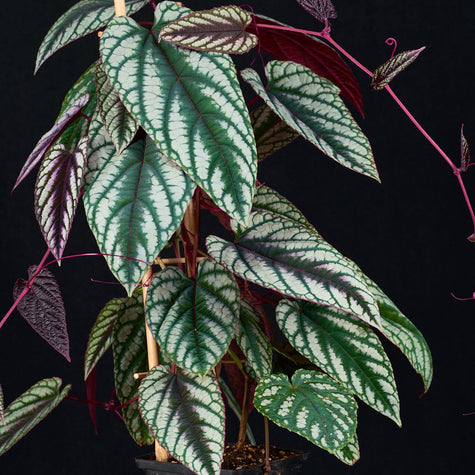
- High - A plant with high water requirements. This refers to two types of plants: those that should always remain moist to wet and quickly show damage if the substrate becomes too dry, even before it has completely dried (e.g., Begonia baik), and those that simply consume a lot of water very quickly and therefore need to be watered unusually often, e.g., Cissus discolor.
For mounted or loose plants, this refers to those that need constantly moist substrate or need to be sprayed one to several times a day to survive. Examples: Lepanthes calodictyon, Tillandsia usneoides 'Fine'.
The plant's nutrient requirements.
- Low - Plants that grow best with small (but not infrequent!) doses of fertilizer. These plants often have naturally slow growth and absorb few nutrients, so too much fertilizer risks damaging their roots. Typical guideline values for mineral fertilization are 150 to 300 µS/cm. Examples: Alocasia melo, Anthurium luxurians, Begonia baik, Teratophyllum rotundifoliatum.
- Moderate - Typical tropical houseplant. It should be regularly supplied with about 400 to 800 µS/cm of fertilizer. Typically every 2 weeks during the growing season from April to October, year-round if kept under grow lights. Examples: Alocasia zebrina, Philodendron melanochrysum, Hoya wayettii.
- High - A plant with high nutrient requirements. These are usually very fast-growing plants that should be supplied with about 1,000 to 2,000 µS/cm of fertilizer, every other week or even weekly depending on the species. These are often, but not always, plants with a distinct winter dormancy. Examples: Monstera deliciosa, Amorphophallus konjac, Fredclarkeara After Dark 'Black Pearl'.
Indicates whether a plant has a natural dormancy period.
This can be either a true winter dormancy, triggered by falling temperatures and diminishing light, or a drought dormancy, triggered by lack of water. Examples: Amorphophallus konjac, Begonia pteridiformis.
This also includes plants that do not undergo "hard" (obligate) dormancy but still take a break from growth (usually over winter) and also lose most of their leaves. Examples: Begonia 'Escargot', Alocasia sanderiana.
Indicates the typical growth habit of the plant if it can grow undisturbed. Plants can have multiple growth habits, and the transitions are fluid.
Solitary - Plants that do not grow woody but show upright and sparsely branched growth. Examples: Alocasia zebrina, Begonia darthvaderiana, Phalaenopsis schilleriana, Cyrtostachys renda.
Shrub - Like herb, but for more branched plants, also includes woody plants. Examples: Begonia minutifolia, Alpinia galanga, Hibiscus rosa-sinensis.
Groundcover - Very similar to shrub, but stays flat on the ground. Not necessarily small plants! Examples: Selaginella uncinata, Geogenanthus ciliatus, Fittonia albivenis.
Climber - Plant with climbing growth, which includes plants that twine or hold on with their roots. Examples: Philodendron melanochrysum, Cissus discolor, Begonia lichenora.
Trailing plant - Plant that actually grows in a hanging manner, i.e., not something like a climber that simply doesn't find a support. Examples: Columnea gloriosa, Huperzia squarrosa, Phalaenopsis schilleriana.
Tree - Woody plant with secondary thickening growth. Example: Theobroma cacao.
Scrambler - Plant that does not have developed organs for climbing, but in nature leans on other plants to grow tall. They often grow in meadows. These plants often have "too thin" stems to stand on their own and need to be supported as they grow larger. Examples: Phyllanthus urinaria, Begonia negrosensis, Peperomia involucrata.
Indicates the typical growth rate of the plant under ideal conditions.
Slow - A truly slow-growing plant, even compared to its closer relatives. Usually produces only a few leaves per year or takes months to noticeably change in size. Often also quite difficult plants, as they react slowly to incorrect conditions. Example: Anthurium luxurians, Licuala mattanensis, Sarcopyramis sp. Sumatra.
Medium - Plant with a typical growth rate for tropical plants. Several new leaves per month and, with good care, twice as large after a few months as at the beginning. Example: Begonia maculata, Rhapidophora tetrasperma, Calathea ornata.
Fast - Fast-growing plants that can truly become "weeds" under good conditions. However, they often need really good conditions to achieve this speed. Example: Alocasia nebula, Monstera siltepecana, Cissus discolor.
Indicates the climate from which the plant originates and also the conditions we recommend for its care.
tropical - Plant from the warm and humid tropical forests.
- Ideal temperatures are 22 - 28°C during the day, not below 20°C at night. Many of the more robust plants can tolerate significantly lower temperatures, but will not grow as fast.
- Humidity of 70 - 99% RH is ideal. Many of the more robust plants can tolerate lower humidity, but will not grow as fast and will not develop such large leaves.
subtropical - Plant from the subtropics. Often these plants have a dry dormancy period or must cope with significantly fluctuating conditions. They are usually robust and well-suited as houseplants.
- Ideal temperatures are 18 - 30°C during the day, not below 14°C at night. Many of the more robust plants can tolerate lower temperatures, but will then not grow as fast/at all.
- Humidity of 50 - 75% RH is ideal. Many of the more robust plants can tolerate lower humidity, but will then not grow as fast and will not develop such large leaves.
temperate - Here we group together all plants that can tolerate at least light frost. However, as a nursery for tropical plants, we do not differentiate here by the degree of winter hardiness. Details on this are usually found in the product descriptions.
tropical highland - Plants from the tropics that only grow at > 1500m above sea level and are accordingly adapted to a stable highland climate. Their care is considered difficult and usually requires complete climate control, as they must never get too warm, but at the same time require high humidity, bright light and strong air circulation.
- Ideal temperatures are 20 - 22°C during the day, not above 15°C at night.
- Humidity of 70 - 99% RH.
Indicates the approximate width and height that the plants will reach with good care.
For climbing plants and ground covers, which can theoretically grow infinitely large, the approximate width and height they will reach after 1 to 2 years of good care in a pot or terrarium are given.
For very densely branching bushes, etc., the typical size is given at which they have either reached their maximum leaf size and no longer significantly change in appearance, or the size at which they first come into bloom.