


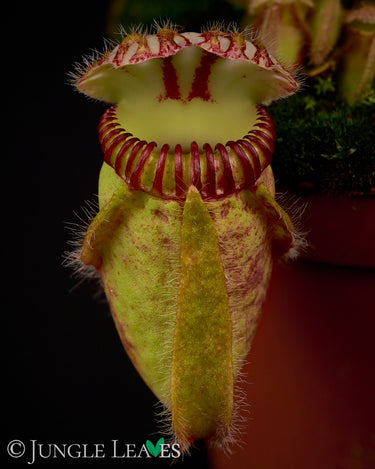


Cephalotus follicularis (dwarf pitcher)
17,99€ EUR
/
Sold out
Tax included.
Shipping calculated at checkout.
 Cephalotus follicularis (dwarf pitcher)
17,99€ EUR
/
Cephalotus follicularis (dwarf pitcher)
17,99€ EUR
/

Cephalotus follicularis (dwarf pitcher)
17,99€ EUR
/
products.product.pickup_availability.unavailable
Description
Cephalotus follicularis , the dwarf pitcher plant, is a carnivorous plant native to a small area in the far southwest of Australia. It grows almost exclusively along riverbanks, slopes, and cliffs in consistently moist sphagnum moss cushions over acidic peat soils or granite.
Although its leaves, modified into pitfall traps, strongly resemble those of pitcher plants ( Nepenthes ), it is not closely related to these (or indeed to any other carnivorous plants)! The pitchers of the dwarf pitcher plant grow up to 5 cm in diameter and lie at an angle on the ground or are embedded in moss cushions. They are filled with a digestive fluid in which trapped insects drown. A lid, which is an outgrowth of the leaf stalk, protects the inside of the pitcher from rain. Four ciliate ridges run from bottom to top on the outside of the pitcher, making it easier for prey to climb inside. The opening of the pitcher is surrounded by ridges that extend into the interior and end in a sharp tooth. This prevents trapped prey from climbing back out, similar to a fish trap. The lid is equipped with transparent strips that allow light to enter the pitcher. As a result, trapped prey animals try to escape to supposed freedom, but instead climb in exactly the wrong direction and slip back into the jug.
In low light conditions, the dwarf pitcher plant also develops normal, spatulate to ovate leaves. It has an underground rhizome that allows it to survive the occasional fires in its habitat.
You will receive a strong plant in a 9cm pot.
Although its leaves, modified into pitfall traps, strongly resemble those of pitcher plants ( Nepenthes ), it is not closely related to these (or indeed to any other carnivorous plants)! The pitchers of the dwarf pitcher plant grow up to 5 cm in diameter and lie at an angle on the ground or are embedded in moss cushions. They are filled with a digestive fluid in which trapped insects drown. A lid, which is an outgrowth of the leaf stalk, protects the inside of the pitcher from rain. Four ciliate ridges run from bottom to top on the outside of the pitcher, making it easier for prey to climb inside. The opening of the pitcher is surrounded by ridges that extend into the interior and end in a sharp tooth. This prevents trapped prey from climbing back out, similar to a fish trap. The lid is equipped with transparent strips that allow light to enter the pitcher. As a result, trapped prey animals try to escape to supposed freedom, but instead climb in exactly the wrong direction and slip back into the jug.
In low light conditions, the dwarf pitcher plant also develops normal, spatulate to ovate leaves. It has an underground rhizome that allows it to survive the occasional fires in its habitat.
You will receive a strong plant in a 9cm pot.
Care tips
Light & Location
Substrate & Repotting
Watering & Fertilizing
What makes us at Jungle Leaves special!


Welcome
Bring the Tropic to Your Home
Jungle Leaves is a team of 3 biologists who breed, propagate and sell extraordinary and unique plants from all over the world, also in cooperation with botanical gardens.