
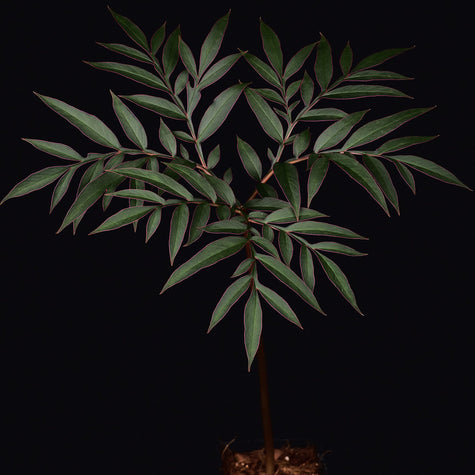


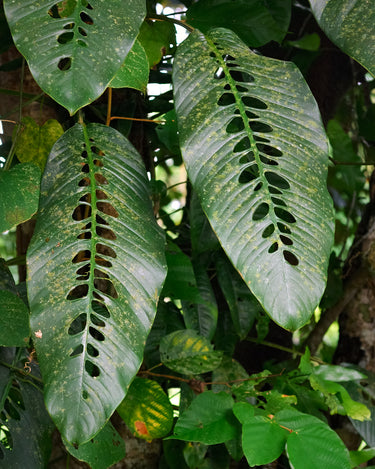


Rhaphidophora foraminifera
24,99€ EUR
/
Sold out
Tax included.
Shipping calculated at checkout.
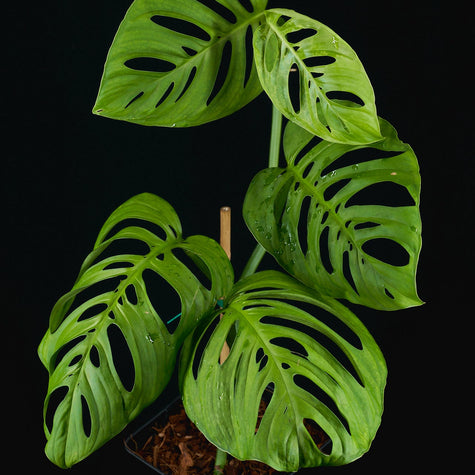
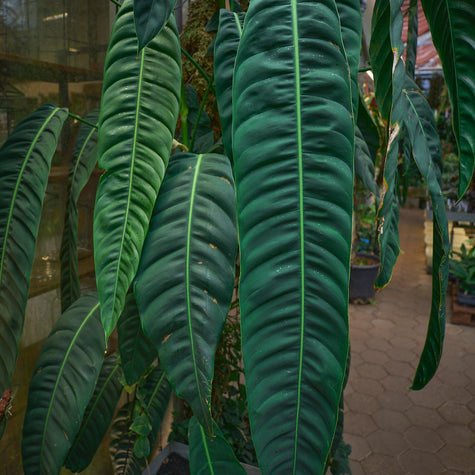
Curiously perforated Rhaphidophora from Borneo with long, slightly wavy leaves. Easy to care for and fast-growing.
 Rhaphidophora foraminifera
24,99€ EUR
/
Rhaphidophora foraminifera
24,99€ EUR
/

Rhaphidophora foraminifera
24,99€ EUR
/
products.product.pickup_availability.unavailable
Description
Rhaphidophora foraminifera originates from the north of the island of Borneo. As a young plant, it has ovate to oblong leaves in a light green hue.
It grows as a vine, climbing trees with its aerial roots, and as it matures, its leaf shape changes completely. The leaves become larger and more elongated (up to about 60 cm) and develop a precise row of holes on both sides next to the midrib. The name " foraminifera " means something like "hole-bearer" and refers to this unusual appearance.
The function of these holes is to simulate insect feeding. Young leaves of Araceae, but also of many other plants (think of palms), are initially tightly rolled up. If an insect, e.g., a caterpillar, feeds on this young leaf, the resulting holes, after unrolling, are all in a precise row because they were previously aligned on top of each other when the leaf was still rolled up.
R. foraminifera mimics precisely this appearance with its rows of holes. Insects with phytophagous larvae preferentially lay their eggs on plants whose leaves do not show such damage, in order to avoid competition among themselves. R. foraminifera exploits this to avoid becoming a target for the insects in the first place by appearing already eaten.
You will receive a strong young plant in a 9cm square pot with fresh new growth.
Preview image by Eric in SF ( CC BY-SA 3.0 )
It grows as a vine, climbing trees with its aerial roots, and as it matures, its leaf shape changes completely. The leaves become larger and more elongated (up to about 60 cm) and develop a precise row of holes on both sides next to the midrib. The name " foraminifera " means something like "hole-bearer" and refers to this unusual appearance.
The function of these holes is to simulate insect feeding. Young leaves of Araceae, but also of many other plants (think of palms), are initially tightly rolled up. If an insect, e.g., a caterpillar, feeds on this young leaf, the resulting holes, after unrolling, are all in a precise row because they were previously aligned on top of each other when the leaf was still rolled up.
R. foraminifera mimics precisely this appearance with its rows of holes. Insects with phytophagous larvae preferentially lay their eggs on plants whose leaves do not show such damage, in order to avoid competition among themselves. R. foraminifera exploits this to avoid becoming a target for the insects in the first place by appearing already eaten.
You will receive a strong young plant in a 9cm square pot with fresh new growth.
Preview image by Eric in SF ( CC BY-SA 3.0 )
Care tips
Light & Location
Substrate & Repotting
Watering & Fertilizing
What makes us at Jungle Leaves special!


Welcome
Bring the Tropic to Your Home
Jungle Leaves is a team of 3 biologists who breed, propagate and sell extraordinary and unique plants from all over the world, also in cooperation with botanical gardens.