

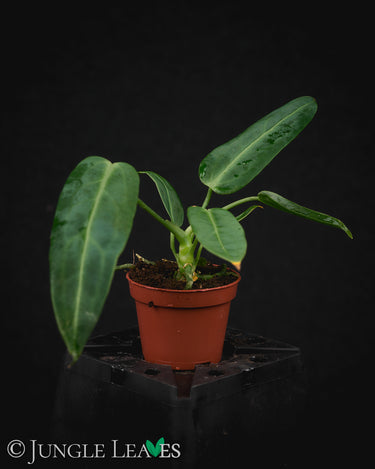


Anthurium warocqueanum
9,99€ EUR
/
Tax included.
Shipping calculated at checkout.
Perhaps the most popular and sought-after of all velvet-leaved anthuriums. Grows huge, but is beautiful even as a small plant. Not a houseplant!
 Anthurium warocqueanum
9,99€ EUR
/
Anthurium warocqueanum
9,99€ EUR
/

Anthurium warocqueanum
9,99€ EUR
/
In stock
products.product.pickup_availability.unavailable
Description
Anthurium warocqueanum originates from a small distribution area in western Colombia, primarily in the departments of Chocó and Antioquia. It grows mainly in the lowlands, at elevations of 0 to 500 meters above sea level, but is occasionally found in the mid-highlands up to approximately 1800 meters. It grows in the so-called Chocó-Darién wetland, a largely untouched, inaccessible rainforest with an average annual rainfall of 4000 to 9000 mm, making Chocó-Darién one of the wettest places on Earth.
Anthurium warocqueanum usually grows epiphytically on larger trees, but never more than 2 to 4 meters above the ground. It does not grow high in the treetops like orchids or bromeliads. Less frequently, specimens are also found terrestrially, but then only on steep slopes where the long leaves do not touch the ground.
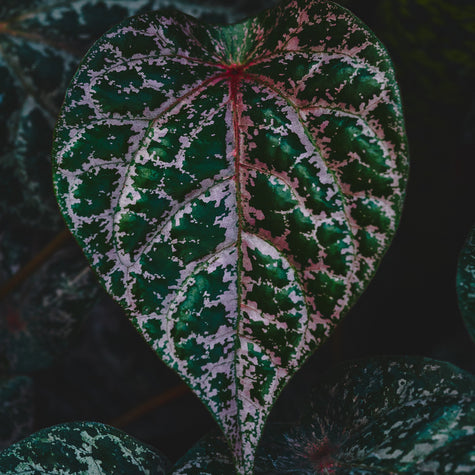
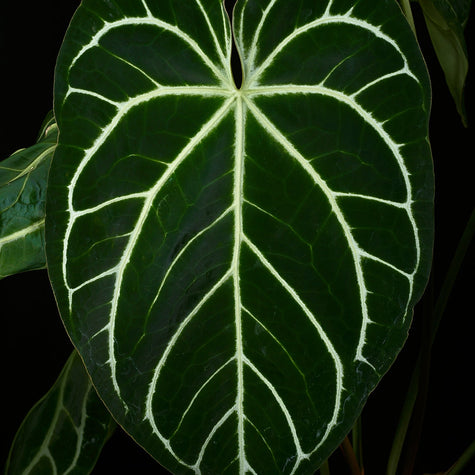
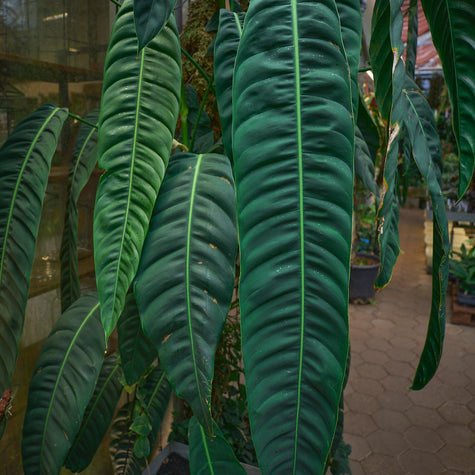
The leaves grow to approximately 100 to 120 cm long and 20 to 40 cm wide. They hang down and are dark green to almost black, with contrasting white veins. The leaves have a velvety, matte appearance. This is typical for plants adapted to low light conditions. The cells of the epidermis have a thickened, convex cuticle that acts like a microlens, focusing the weak, diffuse light in the plant's habitat onto the chloroplasts. Millions of these lenses cover the upper surface of the leaf, giving it its characteristic velvety appearance.
Anthurium warocqueanum exhibits relatively high intraspecific variability (for anthuriums ). Some specimens have rather broad leaves, while others have narrower leaves. However, fully grown plants always develop fairly broad leaves. Leaf coloration is also variable. Some specimens are more green, others almost black. It should be noted, however, that leaf color is strongly influenced by environmental conditions. In low light, the leaves become darker.
Anthurium warocqueanum has a climbing rhizome with numerous adventitious roots. The inflorescences are inconspicuous green, with a greenish-white spadix and a green spathe.
The plant was brought to Europe by the German botanist Gustav Wallis, who collected almost 1000 new plant species, mainly orchids, from Central and South America between 1860 and 1868. Anthurium warocqueanum is named after M. Warocqué, a Belgian plant collector active around this time (not, as many secondary sources, including Wikipedia, claim, Arthur Warocqué. All primary sources refer to one M. Warocqué, even those linked on Wikipedia itself...).
Anthurium warocqueanum is not suitable as a houseplant. Please keep it in a terrarium, grow tent, or plant display case!
Anthurium warocqueanum usually grows epiphytically on larger trees, but never more than 2 to 4 meters above the ground. It does not grow high in the treetops like orchids or bromeliads. Less frequently, specimens are also found terrestrially, but then only on steep slopes where the long leaves do not touch the ground.
The leaves grow to approximately 100 to 120 cm long and 20 to 40 cm wide. They hang down and are dark green to almost black, with contrasting white veins. The leaves have a velvety, matte appearance. This is typical for plants adapted to low light conditions. The cells of the epidermis have a thickened, convex cuticle that acts like a microlens, focusing the weak, diffuse light in the plant's habitat onto the chloroplasts. Millions of these lenses cover the upper surface of the leaf, giving it its characteristic velvety appearance.
Anthurium warocqueanum exhibits relatively high intraspecific variability (for anthuriums ). Some specimens have rather broad leaves, while others have narrower leaves. However, fully grown plants always develop fairly broad leaves. Leaf coloration is also variable. Some specimens are more green, others almost black. It should be noted, however, that leaf color is strongly influenced by environmental conditions. In low light, the leaves become darker.
Anthurium warocqueanum has a climbing rhizome with numerous adventitious roots. The inflorescences are inconspicuous green, with a greenish-white spadix and a green spathe.
The plant was brought to Europe by the German botanist Gustav Wallis, who collected almost 1000 new plant species, mainly orchids, from Central and South America between 1860 and 1868. Anthurium warocqueanum is named after M. Warocqué, a Belgian plant collector active around this time (not, as many secondary sources, including Wikipedia, claim, Arthur Warocqué. All primary sources refer to one M. Warocqué, even those linked on Wikipedia itself...).
Anthurium warocqueanum is not suitable as a houseplant. Please keep it in a terrarium, grow tent, or plant display case!
Care tips
Light & Location
Substrate & Repotting
Watering & Fertilizing
What makes us at Jungle Leaves special!


Welcome
Bring the Tropic to Your Home
Jungle Leaves is a team of 3 biologists who breed, propagate and sell extraordinary and unique plants from all over the world, also in cooperation with botanical gardens.