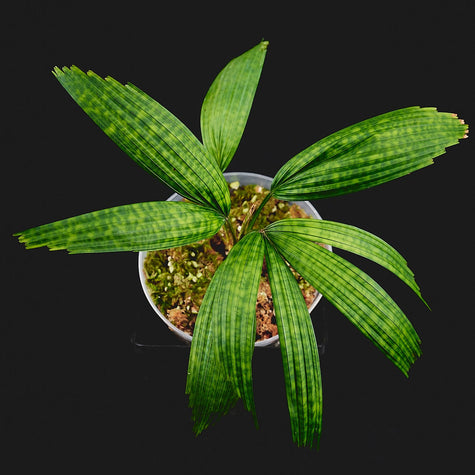


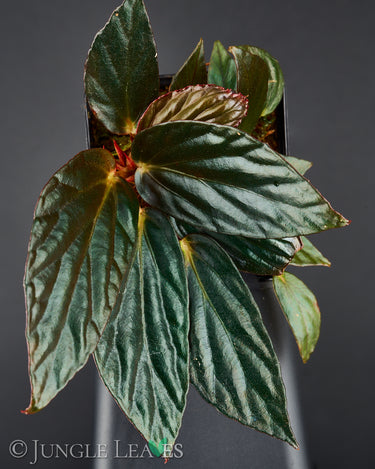


Begonia U639
19,99€ EUR
/
Sold out
Tax included.
Shipping calculated at checkout.
Compact species with unusual growth habit. Good for terrariums. Rarity, offered for the first time in Europe.
 Begonia U639
19,99€ EUR
/
Begonia U639
19,99€ EUR
/

Begonia U639
19,99€ EUR
/
products.product.pickup_availability.unavailable
Description
- Origin: India
- Care: Easy / Medium / Advanced
- Suitable as a houseplant?: Yes / Limited / No
- Suitable locations: Terrarium, plant display case, west-facing window, east-facing window
- Special features: This undescribed species may be a dark form of Begonia hatacoa.
[porto_content_box border_top_color="#1e764d" border_radius="2" border_top_width="2" align="left"]
[expand Title=" Details about the plant "]
Begonia U639 is a species that has not yet been scientifically described, which Darrin Norton of Mountain Orchids in the USA received as a "weed" in a shipment of seeds of another begonia from Vietnam.
It has been suggested that Begonia U639 is a dark-leaved variety of Begonia hatacoa (pers. comm., 2015 Dr. Ching-I Peng), specifically Begonia hatacoa var. rubrifolia . The problem is that Begonia hatacoa var. rubrifolia does not exist. The name has only been mentioned once, in 2006 in issue 73 of the American Begonia Society's magazine "Begonian." No type specimen for this variety has been deposited anywhere; therefore, this is an invalid name ( nomen nudum ).
The differences between Begonia U639 and *B. hatacoa* extend beyond mere leaf color. The growth habit also differs markedly. The nominate form, as well as the accepted variant *var. meisneri*, tend to grow with drooping leaves instead of the striking, upright leaves of U639. These differences alone are certainly not sufficient to disqualify this plant from being classified as *B. hatacoa* . The flowers, which are very similar to those of *B. hatacoa* in shape and color, further support the conclusion that this is indeed an unusual form of *B. hatacoa *.
In nature, there is indeed at least one population of *B. hatacoa * that closely resembles the appearance of *B. U639*. In February 2021, Shankar Raman discovered a population of plants identified as *B. hatacoa* in northern India (Meghalaya), near the border with Bangladesh, which look like *B. hatacoa*. These plants grow at altitudes of 400 to 600 meters as lithophytes directly on limestone rocks or in crevices and fissures within these rocks, which are filled with a small amount of soil and moss.
The climate there is warm and, due to the annual monsoon, very, very wet. From June to September, daytime temperatures are almost always above 30°C and nighttime temperatures rarely drop below 23°C, accompanied by exceptionally heavy rainfall. The dry season, from November to February, is characterized by strong, cool, and dry northeasterly winds from the Siberian highlands. During this time, daytime temperatures are only around 24°C, and nighttime temperatures cool down to around 12°C. This begonia usually sheds all its leaves during this period and survives as a rhizome.
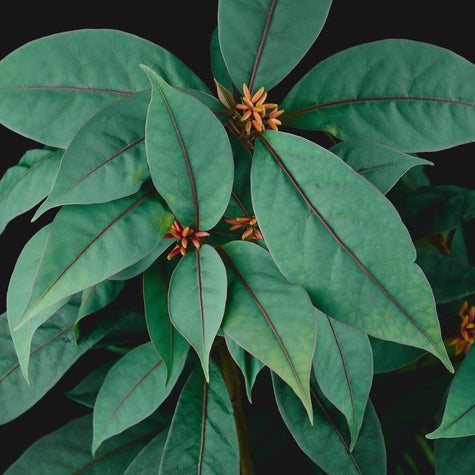
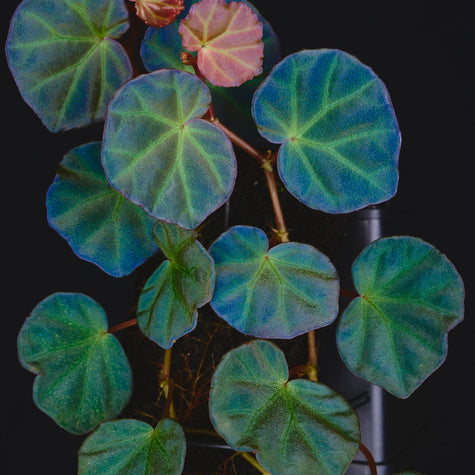
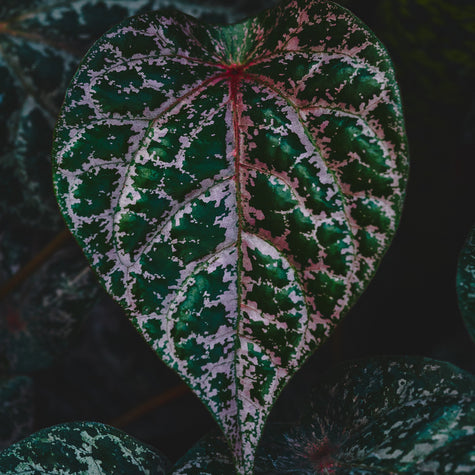
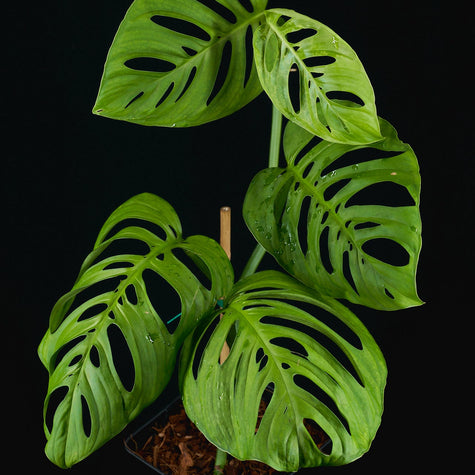
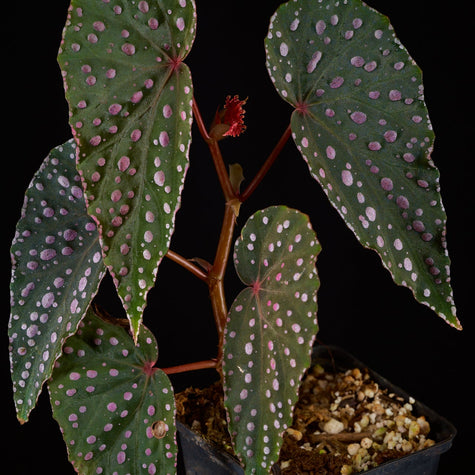
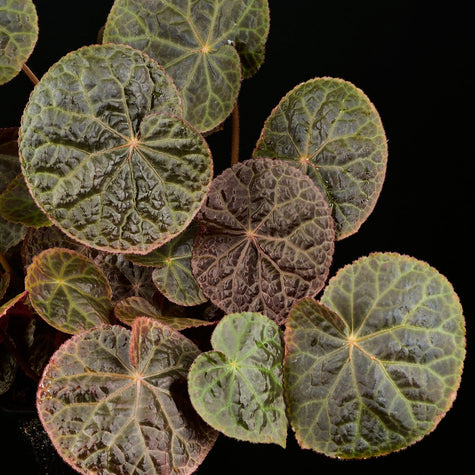
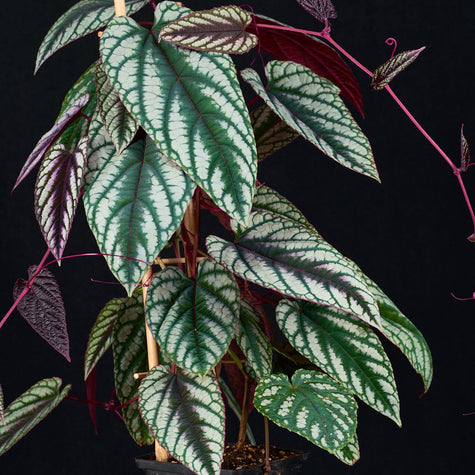
Begonia U639 grows with almost vertical, pointed leaves that are glossy dark green to bluish on the upper surface. The undersides of the leaves are deep red with yellowish veins. Their almost vertical growth habit makes them particularly striking. The leaves are borne on short, very finely but densely hairy, sturdy stems that grow from a creeping rhizome. The overall growth habit remains very compact. The leaves reach a length of approximately 12 cm.
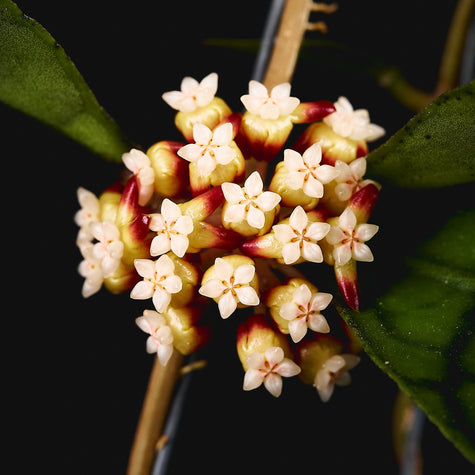
Begonia U639 blooms with pretty, pink/white striped flowers on stems about 20 cm high.
Within the begonias, it belongs to the section Platycentrum .
[/expand]
[/porto_content_box]
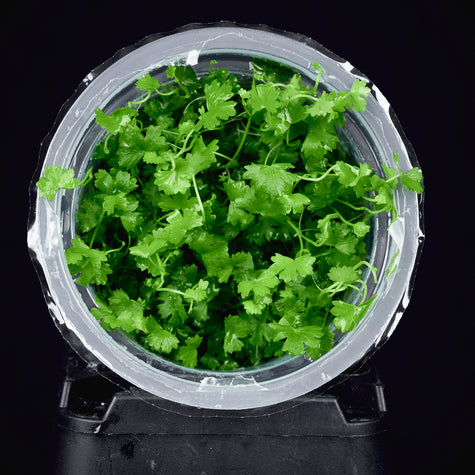
You will receive a young plant in a 7cm square pot.
Care tips
Light & Location
Substrate & Repotting
Watering & Fertilizing
What makes us at Jungle Leaves special!


Welcome
Bring the Tropic to Your Home
Jungle Leaves is a team of 3 biologists who breed, propagate and sell extraordinary and unique plants from all over the world, also in cooperation with botanical gardens.