



Cryptocoryne striolata
19,99€ EUR
/
Sold out
Tax included.
Shipping calculated at checkout.
 Cryptocoryne striolata
19,99€ EUR
/
Cryptocoryne striolata
19,99€ EUR
/

Cryptocoryne striolata
19,99€ EUR
/
products.product.pickup_availability.unavailable
Description
Cryptocoryne striolata is a highly variable water trumpet ( Cryptocoryne ) from Borneo. The species is widespread and typically grows in small and large rainforest streams on sandbars over granite soils. These sandbars regularly dry out (during the dry season). The plants are adapted to this and flower at this time.
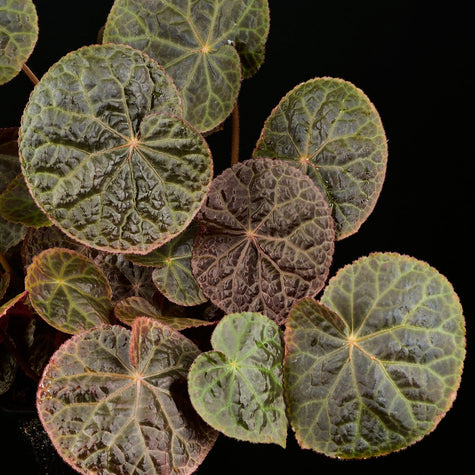
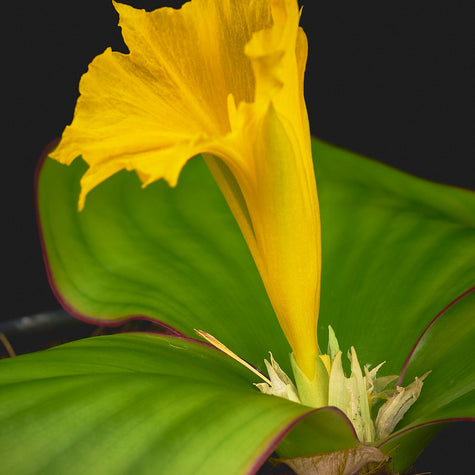
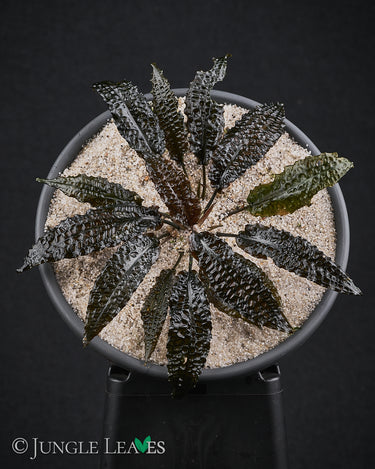
*C. striolata* is highly variable and can look different depending on location, environmental conditions, and season. There are specimens with green, smooth leaves, those with bullate leaves (raised areas between the veins that make the leaf appear indented), and those with dark brown to almost black leaves. Even the same plant can produce green or dark leaves depending on environmental conditions. Species identification is only possible via the inflorescences. *C. striolata* has a very long, but only slightly twisted spathe with a striking red to pinkish, dark spot at the opening. An overview of the species' variability and further images of the inflorescences can be found here .
Our plants are initially green and develop dark leaves when grown emersed in low light. Fresh leaves display a beautiful, metallic red sheen in the leaf axils. This species is considered very difficult to cultivate submerged. We therefore recommend this water trumpet only for emersed cultivation, where, in our experience, it is easy to care for and also flowers regularly.
This species exhibits a very interesting adaptation to a partially flooded environment. After some time, it develops numerous, very fine, negatively gravitropic (i.e., upward-growing) roots. These protrude approximately 1 to 2 cm from the substrate and have a similar effect to mangrove roots. Water flowing over the roots is swirled and slowed down, causing suspended particles to accumulate around the plant. The plant then feeds on this silt and detritus. This works best at low water levels, precisely when the water level of streams recedes during the dry season.
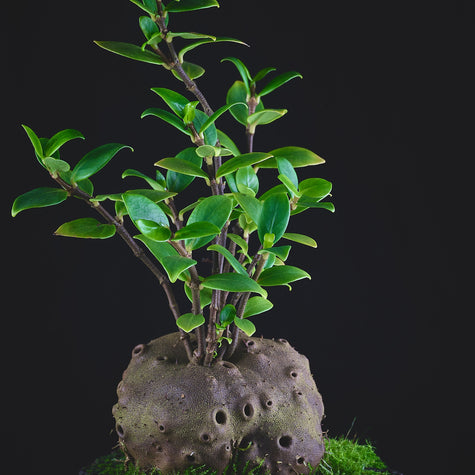
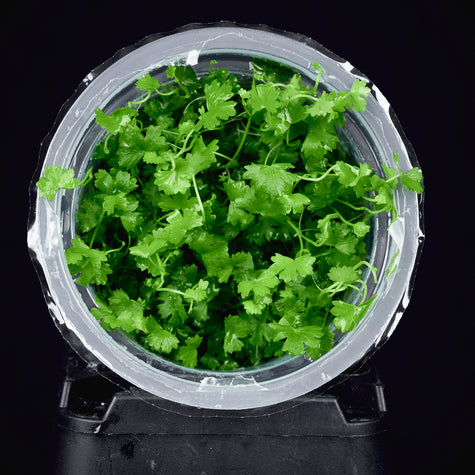
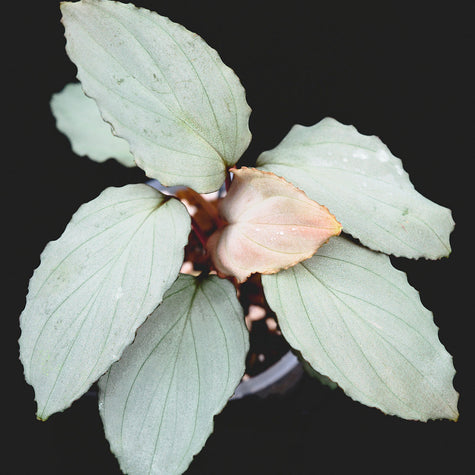
You will receive a strong, well-rooted, emersed-grown plant in a 7cm pot (see picture 3 in the gallery). These plants mostly still have green leaves. The dark coloration develops later.
*C. striolata* is highly variable and can look different depending on location, environmental conditions, and season. There are specimens with green, smooth leaves, those with bullate leaves (raised areas between the veins that make the leaf appear indented), and those with dark brown to almost black leaves. Even the same plant can produce green or dark leaves depending on environmental conditions. Species identification is only possible via the inflorescences. *C. striolata* has a very long, but only slightly twisted spathe with a striking red to pinkish, dark spot at the opening. An overview of the species' variability and further images of the inflorescences can be found here .
Our plants are initially green and develop dark leaves when grown emersed in low light. Fresh leaves display a beautiful, metallic red sheen in the leaf axils. This species is considered very difficult to cultivate submerged. We therefore recommend this water trumpet only for emersed cultivation, where, in our experience, it is easy to care for and also flowers regularly.
This species exhibits a very interesting adaptation to a partially flooded environment. After some time, it develops numerous, very fine, negatively gravitropic (i.e., upward-growing) roots. These protrude approximately 1 to 2 cm from the substrate and have a similar effect to mangrove roots. Water flowing over the roots is swirled and slowed down, causing suspended particles to accumulate around the plant. The plant then feeds on this silt and detritus. This works best at low water levels, precisely when the water level of streams recedes during the dry season.
You will receive a strong, well-rooted, emersed-grown plant in a 7cm pot (see picture 3 in the gallery). These plants mostly still have green leaves. The dark coloration develops later.
Care tips
Light & Location
Substrate & Repotting
Watering & Fertilizing
What makes us at Jungle Leaves special!


Welcome
Bring the Tropic to Your Home
Jungle Leaves is a team of 3 biologists who breed, propagate and sell extraordinary and unique plants from all over the world, also in cooperation with botanical gardens.