













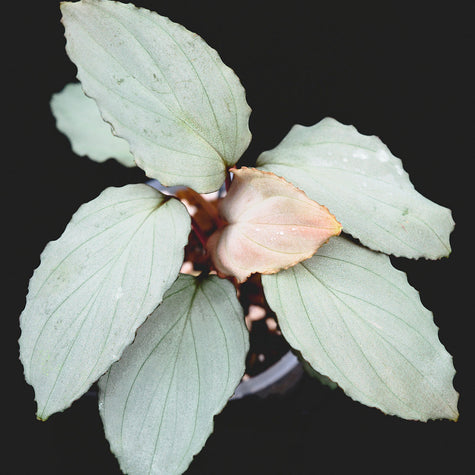


















Ctenanthe pilosa 'Golden Mosaic'
5,99€ EUR
/
Sold out
Tax included.
Shipping calculated at checkout.
 Ctenanthe pilosa 'Golden Mosaic'
5,99€ EUR
/
Ctenanthe pilosa 'Golden Mosaic'
5,99€ EUR
/

Ctenanthe pilosa 'Golden Mosaic'
5,99€ EUR
/
products.product.pickup_availability.unavailable
Description
Ctenanthe pilosa (syn. marantifolia ) 'Golden Mosaic' has beautifully and extensively variegated, light yellow leaves. It grows from an underground rhizome, which serves as a water and nutrient reservoir. Ctenanthe pilosa is a member of the arrowroot family (Marantaceae) and originates from the east coast of South America, specifically Brazil, around the area of São Paulo, Rio de Janeiro, and especially the Serra da Bocaina National Park. There, it grows in wooded areas near the coast. The forests in this region are subtropical. It is warm but not humid year-round like a rainforest. During the dry season, the climate is more Mediterranean.
Some sources consider Ctenanthe pilosa a synonym of Ctenanthe marantifolia . According to the IAPT rules, Ctenanthe marantifolia would be the correct name. However, not all databases agree, which is why both names are currently treated as equivalent synonyms. The name C. pilosa is much more widespread and well-known, which is why we sell the plants under this name.
Arrowroot plants are also called "prayer plants" in English because of the way their leaves move; at night, they fold them upwards like hands in prayer. Generally, the leaves of Marantaceae move relatively quickly and frequently, so these movements (which almost all plants exhibit) are much more noticeable in Marantaceae. This makes them appear truly alive!
Some sources consider Ctenanthe pilosa a synonym of Ctenanthe marantifolia . According to the IAPT rules, Ctenanthe marantifolia would be the correct name. However, not all databases agree, which is why both names are currently treated as equivalent synonyms. The name C. pilosa is much more widespread and well-known, which is why we sell the plants under this name.
Arrowroot plants are also called "prayer plants" in English because of the way their leaves move; at night, they fold them upwards like hands in prayer. Generally, the leaves of Marantaceae move relatively quickly and frequently, so these movements (which almost all plants exhibit) are much more noticeable in Marantaceae. This makes them appear truly alive!
Care tips
Light & Location
Substrate & Repotting
Watering & Fertilizing
What makes us at Jungle Leaves special!


Welcome
Bring the Tropic to Your Home
Jungle Leaves is a team of 3 biologists who breed, propagate and sell extraordinary and unique plants from all over the world, also in cooperation with botanical gardens.