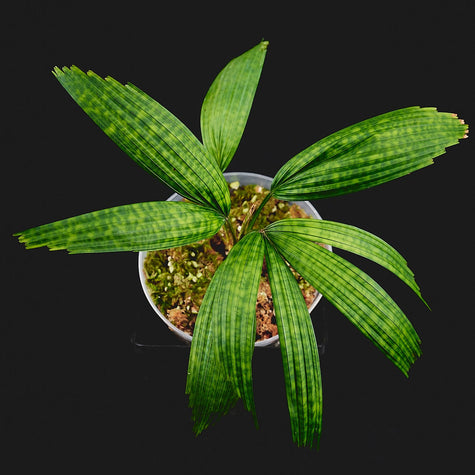
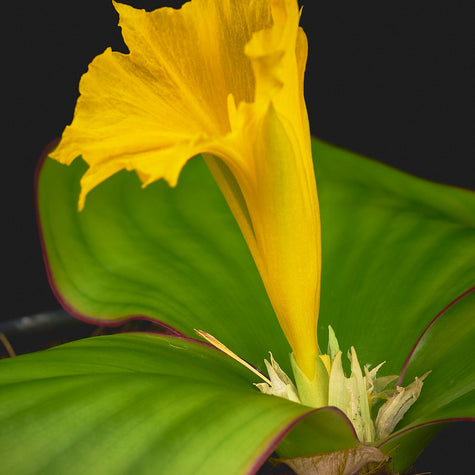


Cyrtosperma cf. giganteum
79,99€ EUR
/
Sold out
Tax included.
Shipping calculated at checkout.
 Cyrtosperma cf. giganteum
79,99€ EUR
/
Cyrtosperma cf. giganteum
79,99€ EUR
/

Cyrtosperma cf. giganteum
79,99€ EUR
/
products.product.pickup_availability.unavailable
Description
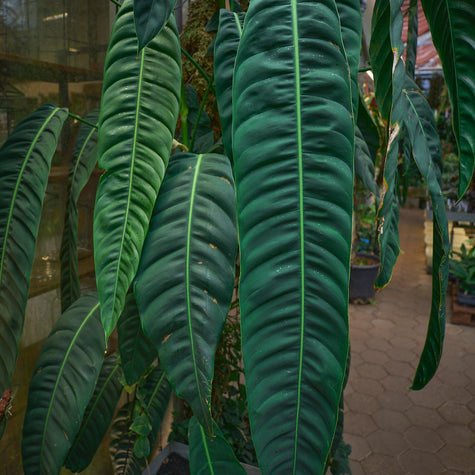
Arum plants of the genus Cyrtosperma are still almost unknown in Europe, yet they are beautiful and very easy to care for.
These are marsh plants that grow in the seasonally monsoon-flooded forests of Papua New Guinea, Indonesia, and surrounding islands. They even tolerate brackish water.
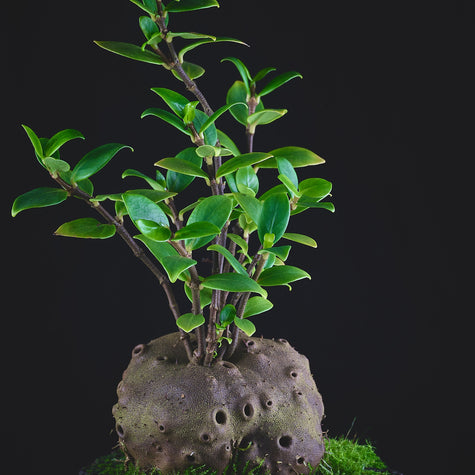
They have an upright growth habit with vertically borne leaves, similar to some Alocasia varieties. They invariably grow large, reaching heights of 2 to 4 meters. The leaves are pointed and arrow-shaped. They form a very thick rhizome, which can also grow to over 2 meters in length and is cooked and eaten in their native habitat. Mature rhizomes can weigh over 100 kg! This makes it the largest vegetable in the world.
The plants offered here probably belong to the species C. giganteum , an extremely rare species which has only been found a few times in nature.
It was first collected in 1907 by the Dutch botanist Gerard Martinus Versteeg and in 1909 by the Dutch physician and psychiatrist Lucien Albert Marie von Römer.
Based on Versteeg's collection, Adolf Engler named the plant Cyrtosperma giganteum. After that, there were no further scientific records of the species for more than 90 years (!) until it was rediscovered in 1999 and 2000 during two expeditions in southern Papua. However, this rediscovery of the plant was not published, apart from a single photograph used to illustrate the genus Cyrtosperma in Plants of the World Online. It wasn't until December 2020 that this species was found again and this time scientifically studied ( link to the paper ).
The plants we offer here arrived in Europe as seeds from Papua in September 2020, harvested from cultivated mother plants grown for vegetable production and apparently never identified as the much rarer C. giganteum . Initially, they were identified as the commonly cultivated C. merkusii . As they grew and it became clear that they were something else, they were then identified as Cyrtosperma sp. "Papua" and finally (provisionally) as C. giganteum .
These plants, however, show some striking differences from the very few known descriptions of C. giganteum . For example, the petioles are significantly shorter and the leaves are strongly irregularly wavy. Therefore, whether they are indeed C. giganteum is still not definitively established.
These are marsh plants that grow in the seasonally monsoon-flooded forests of Papua New Guinea, Indonesia, and surrounding islands. They even tolerate brackish water.
They have an upright growth habit with vertically borne leaves, similar to some Alocasia varieties. They invariably grow large, reaching heights of 2 to 4 meters. The leaves are pointed and arrow-shaped. They form a very thick rhizome, which can also grow to over 2 meters in length and is cooked and eaten in their native habitat. Mature rhizomes can weigh over 100 kg! This makes it the largest vegetable in the world.
The plants offered here probably belong to the species C. giganteum , an extremely rare species which has only been found a few times in nature.
It was first collected in 1907 by the Dutch botanist Gerard Martinus Versteeg and in 1909 by the Dutch physician and psychiatrist Lucien Albert Marie von Römer.
Based on Versteeg's collection, Adolf Engler named the plant Cyrtosperma giganteum. After that, there were no further scientific records of the species for more than 90 years (!) until it was rediscovered in 1999 and 2000 during two expeditions in southern Papua. However, this rediscovery of the plant was not published, apart from a single photograph used to illustrate the genus Cyrtosperma in Plants of the World Online. It wasn't until December 2020 that this species was found again and this time scientifically studied ( link to the paper ).
The plants we offer here arrived in Europe as seeds from Papua in September 2020, harvested from cultivated mother plants grown for vegetable production and apparently never identified as the much rarer C. giganteum . Initially, they were identified as the commonly cultivated C. merkusii . As they grew and it became clear that they were something else, they were then identified as Cyrtosperma sp. "Papua" and finally (provisionally) as C. giganteum .
These plants, however, show some striking differences from the very few known descriptions of C. giganteum . For example, the petioles are significantly shorter and the leaves are strongly irregularly wavy. Therefore, whether they are indeed C. giganteum is still not definitively established.
Care tips
Light & Location
Substrate & Repotting
Watering & Fertilizing
What makes us at Jungle Leaves special!


Welcome
Bring the Tropic to Your Home
Jungle Leaves is a team of 3 biologists who breed, propagate and sell extraordinary and unique plants from all over the world, also in cooperation with botanical gardens.