





Monstera sp. 'Esqueleto' ("epipremnoides")
11,99€ EUR
/
Sold out
Tax included.
Shipping calculated at checkout.
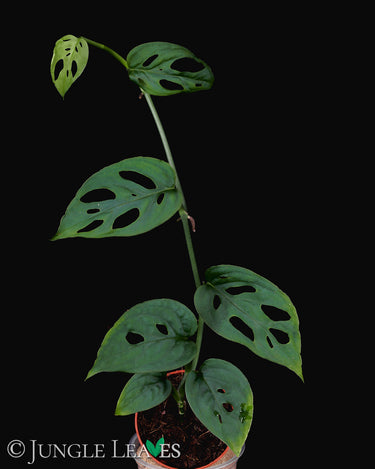
'Esqueleto' Monstera with leaves up to 80 cm long with huge holes. Absolutely spectacular.
 Monstera sp. 'Esqueleto' ("epipremnoides")
11,99€ EUR
/
Monstera sp. 'Esqueleto' ("epipremnoides")
11,99€ EUR
/

Monstera sp. 'Esqueleto' ("epipremnoides")
11,99€ EUR
/
products.product.pickup_availability.unavailable
Description
Before we get into the rather complicated clarification of this plant's identity, just a quick heads-up: Yes, this is the really big one with the really great drooping leaves.
So, now to Monstera taxonomy, my "favorite" topic.
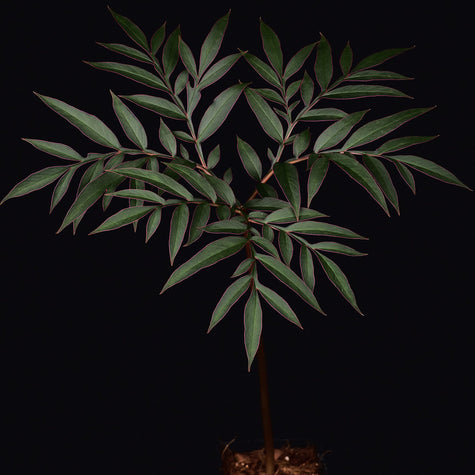
This plant, which is often (still) sold as Monstera epipremnoides , is most likely not M. epipremnoides . The true M. epipremnoides is a stenotopic (i.e., low tolerance to changing environmental factors) Monstera from the mountains of Costa Rica. There, it only grows at altitudes of 800–1800 m and cannot tolerate the warm temperatures of the lowlands. As a mature plant, it has pinnately lobed leaves approximately 35–55 cm long and 22–35 cm wide. This means the leaves are deeply dissected, just like those of an Epipremnum pinnatum , after which it is named ( epipremnoides = "like an Epipremnum "). Here is a picture of an M. epipremnoides in its natural habitat. Here is a herbarium specimen of a mature plant. The true M. epipremnoides is, to my knowledge, not currently in circulation.
The Monstera offered here was considered to be *M. epipremnoides* for several years, probably because it looked quite similar to it as a young plant . However, this proved to be incorrect years ago (specifically in 2018), because as these plants grew larger, it became clear that this must be a different, previously undescribed Monstera . This undescribed Monstera was then officially registered in 2018 by the International Aroid Society as the cultivar ' Esqueleto '. The name is Spanish for "skeleton," which I find very fitting.
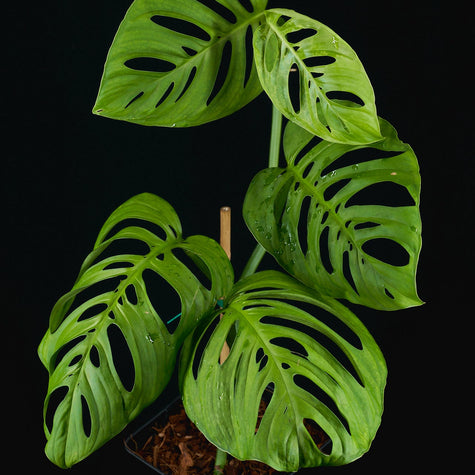
Monstera 'Esqueleto' differs from Monstera epipremnoides in several striking characteristics. It develops significantly larger leaves, up to 80 cm long and 40 cm wide (!), and these are not pinnately lobed. They have very large perforations that extend almost to the leaf margin, as well as a series of smaller perforations along the midrib. Due to these large perforations, the leaves tend to droop and, once they reach a certain size, hang down under their own weight. Also very noticeable is its altered growth habit when it reaches its mature size. The internodal distances become very short, and it develops two opposite rows of leaves.
Monstera sp. 'Esqueleto' will likely be described as a separate species in the future. Until then, it should be labelled with the suffix " sp. " after the genus name as a distinct, but unnamed, species and should no longer be sold as M. epipremnoides , with which it has very little in common.
So, now to Monstera taxonomy, my "favorite" topic.
This plant, which is often (still) sold as Monstera epipremnoides , is most likely not M. epipremnoides . The true M. epipremnoides is a stenotopic (i.e., low tolerance to changing environmental factors) Monstera from the mountains of Costa Rica. There, it only grows at altitudes of 800–1800 m and cannot tolerate the warm temperatures of the lowlands. As a mature plant, it has pinnately lobed leaves approximately 35–55 cm long and 22–35 cm wide. This means the leaves are deeply dissected, just like those of an Epipremnum pinnatum , after which it is named ( epipremnoides = "like an Epipremnum "). Here is a picture of an M. epipremnoides in its natural habitat. Here is a herbarium specimen of a mature plant. The true M. epipremnoides is, to my knowledge, not currently in circulation.
The Monstera offered here was considered to be *M. epipremnoides* for several years, probably because it looked quite similar to it as a young plant . However, this proved to be incorrect years ago (specifically in 2018), because as these plants grew larger, it became clear that this must be a different, previously undescribed Monstera . This undescribed Monstera was then officially registered in 2018 by the International Aroid Society as the cultivar ' Esqueleto '. The name is Spanish for "skeleton," which I find very fitting.
Monstera 'Esqueleto' differs from Monstera epipremnoides in several striking characteristics. It develops significantly larger leaves, up to 80 cm long and 40 cm wide (!), and these are not pinnately lobed. They have very large perforations that extend almost to the leaf margin, as well as a series of smaller perforations along the midrib. Due to these large perforations, the leaves tend to droop and, once they reach a certain size, hang down under their own weight. Also very noticeable is its altered growth habit when it reaches its mature size. The internodal distances become very short, and it develops two opposite rows of leaves.
Monstera sp. 'Esqueleto' will likely be described as a separate species in the future. Until then, it should be labelled with the suffix " sp. " after the genus name as a distinct, but unnamed, species and should no longer be sold as M. epipremnoides , with which it has very little in common.
Care tips
Light & Location
Substrate & Repotting
Watering & Fertilizing
What makes us at Jungle Leaves special!


Welcome
Bring the Tropic to Your Home
Jungle Leaves is a team of 3 biologists who breed, propagate and sell extraordinary and unique plants from all over the world, also in cooperation with botanical gardens.