



Myrmecodia aff. platytyrea
19,99€ EUR
/
Sold out
Tax included.
Shipping calculated at checkout.
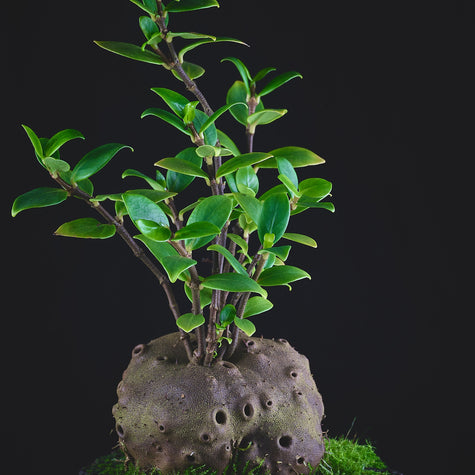
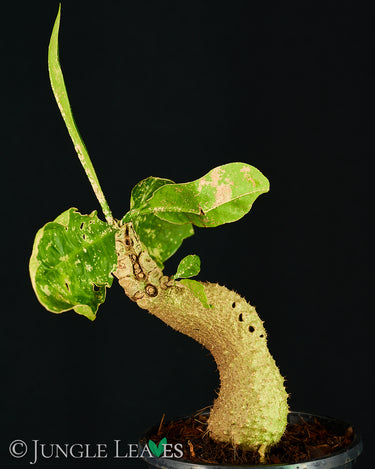
Decorative ant plant with a long, spiny caudex.
 Myrmecodia aff. platytyrea
19,99€ EUR
/
Myrmecodia aff. platytyrea
19,99€ EUR
/

Myrmecodia aff. platytyrea
19,99€ EUR
/
products.product.pickup_availability.unavailable
Description
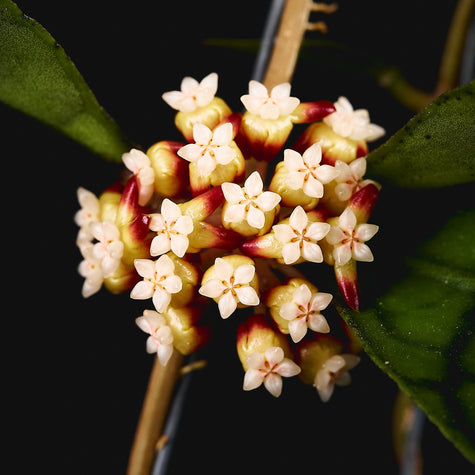
We received this ant plant as * Myrmecodia echinata* , however, according to current taxonomy, *M. echinata* is not recognized as a separate species and is listed as a synonym of *Myrmecodia tuberosa* . Our plants are certainly not * M. tuberosa* ; they bear a much greater resemblance to *Myrmecodia platytyrea *. The upright, unbranched growth habit and the clearly defined scales at the leaf bases are characteristic, as is the spiny caudex. The flowers are white and four-petaled, the fruits long and orange.
Myrmecodia platytyrea is known from Papua New Guinea and northern Queensland.
General: Ant plants from the Rubiaceae family (subfamily Hydnophytinae) have undergone fascinating adaptations to their habitat.
They live epiphytically on trees in Southeast Asia and, like orchids and other epiphytic plants, depend on regular rain and the supply of nutrients.
These plants have overcome nutrient scarcity through a mutualistic relationship with ants. The greatly thickened stem (here the hypocotyl) is riddled with numerous chambers that serve as a safe haven for the ants. Some of these chambers are capable of absorbing nutrients, which the ants continuously replenish. The caudex also serves as a water reservoir for dry days. In older specimens, the thickened stem can measure up to 50 cm or more. However, the plants are not dependent on the presence of ants, as they can easily be cultivated and brought to flower without them.
In most species, the flowers can self-pollinate, so there are always small red berries hanging on the branches.
A very rewarding vivarium plant. After acclimatization, it can also be grown as a houseplant. In a 5 cm pot.
Myrmecodia platytyrea is known from Papua New Guinea and northern Queensland.
General: Ant plants from the Rubiaceae family (subfamily Hydnophytinae) have undergone fascinating adaptations to their habitat.
They live epiphytically on trees in Southeast Asia and, like orchids and other epiphytic plants, depend on regular rain and the supply of nutrients.
These plants have overcome nutrient scarcity through a mutualistic relationship with ants. The greatly thickened stem (here the hypocotyl) is riddled with numerous chambers that serve as a safe haven for the ants. Some of these chambers are capable of absorbing nutrients, which the ants continuously replenish. The caudex also serves as a water reservoir for dry days. In older specimens, the thickened stem can measure up to 50 cm or more. However, the plants are not dependent on the presence of ants, as they can easily be cultivated and brought to flower without them.
In most species, the flowers can self-pollinate, so there are always small red berries hanging on the branches.
A very rewarding vivarium plant. After acclimatization, it can also be grown as a houseplant. In a 5 cm pot.
Care tips
Light & Location
Substrate & Repotting
Watering & Fertilizing
What makes us at Jungle Leaves special!


Welcome
Bring the Tropic to Your Home
Jungle Leaves is a team of 3 biologists who breed, propagate and sell extraordinary and unique plants from all over the world, also in cooperation with botanical gardens.