

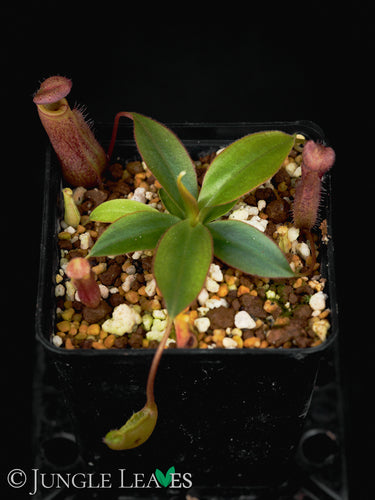


Nepenthes attenboroughii (Mt. Victoria, Palawan)
Tax included.
Shipping calculated at checkout.
One of the largest of all pitcher plants, with enormous, funnel-shaped pitchers. A very pretty species.
 Nepenthes attenboroughii (Mt. Victoria, Palawan)
74,76€ EUR
49,99€ EUR
/

Nepenthes attenboroughii (Mt. Victoria, Palawan)
products.product.pickup_availability.unavailable
Description
This species, only described in 2007 and named after Sir David Attenborough, produces some of the largest pitchers in the genus.
It is only found on the slopes of Mt. Victoria on the Philippine island of Palawan at altitudes of 1450 to 1726 meters, and is therefore considered a highland species.
It grows very large. The leaves can reach 40 cm in length, sometimes even up to 60 cm. It reaches a diameter of approximately 100 cm and a length of several meters. It grows slowly, typical of highland Nepenthes . The bell- to cone-shaped pitchers grow up to 30 cm high and 16 cm wide. They have a volume of up to 2 liters and are thus, along with those of Nepenthes rajah , the largest in the genus.
Nepenthes attenboroughii became famous after its discovery primarily due to sensationalist press reports claiming that this plant could trap and kill rats. While it is certainly large enough to occasionally catch rodents, this is extremely rare. Like most Nepenthes species, it feeds on insects and other arthropods.
The pitchers of N. attenboroughii are unusual, as they have only a small lid that does not protect the digestive fluid inside from rain. The pitchers are therefore often completely filled with liquid. Instead of protecting the interior from rain, the pitchers contain two liquids of different viscosities. In the upper part of the pitcher, the liquid is watery (mostly just rainwater). In the lower part, however, the actual digestive fluid is viscous and does not mix with the water above it. Captured prey drowns in the upper part and then sinks into the viscous lower part of the pitcher, where it is not washed out even in heavy rain.
Due to the required significant nighttime temperature drop and the sensitivity of this species, it should be reserved for experienced Nepenthes keepers.
You will receive a well-hardened young plant, approximately 5 to 10cm in diameter in a 7cm pot.
Clone: BCP N1316-1320
It is only found on the slopes of Mt. Victoria on the Philippine island of Palawan at altitudes of 1450 to 1726 meters, and is therefore considered a highland species.
It grows very large. The leaves can reach 40 cm in length, sometimes even up to 60 cm. It reaches a diameter of approximately 100 cm and a length of several meters. It grows slowly, typical of highland Nepenthes . The bell- to cone-shaped pitchers grow up to 30 cm high and 16 cm wide. They have a volume of up to 2 liters and are thus, along with those of Nepenthes rajah , the largest in the genus.
Nepenthes attenboroughii became famous after its discovery primarily due to sensationalist press reports claiming that this plant could trap and kill rats. While it is certainly large enough to occasionally catch rodents, this is extremely rare. Like most Nepenthes species, it feeds on insects and other arthropods.
The pitchers of N. attenboroughii are unusual, as they have only a small lid that does not protect the digestive fluid inside from rain. The pitchers are therefore often completely filled with liquid. Instead of protecting the interior from rain, the pitchers contain two liquids of different viscosities. In the upper part of the pitcher, the liquid is watery (mostly just rainwater). In the lower part, however, the actual digestive fluid is viscous and does not mix with the water above it. Captured prey drowns in the upper part and then sinks into the viscous lower part of the pitcher, where it is not washed out even in heavy rain.
Due to the required significant nighttime temperature drop and the sensitivity of this species, it should be reserved for experienced Nepenthes keepers.
You will receive a well-hardened young plant, approximately 5 to 10cm in diameter in a 7cm pot.
Clone: BCP N1316-1320
Care tips
Light & Location
Substrate & Repotting
Watering & Fertilizing
What makes us at Jungle Leaves special!


Welcome
Bring the Tropic to Your Home
Jungle Leaves is a team of 3 biologists who breed, propagate and sell extraordinary and unique plants from all over the world, also in cooperation with botanical gardens.