

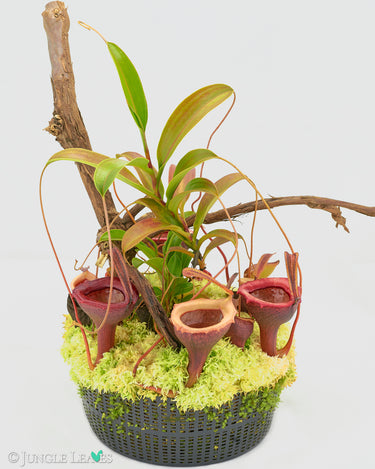


Nepenthes jamban (Barisan Mountains, Sumatra)
39,99€ EUR
/
Sold out
Tax included.
Shipping calculated at checkout.
A small, delicate pitcher plant with quirky, toilet-shaped pitchers. Very pretty, but not easy to care for!
 Nepenthes jamban (Barisan Mountains, Sumatra)
39,99€ EUR
/
Nepenthes jamban (Barisan Mountains, Sumatra)
39,99€ EUR
/

Nepenthes jamban (Barisan Mountains, Sumatra)
39,99€ EUR
/
products.product.pickup_availability.unavailable
Description
This pitcher plant, only described in 2006 and named after the Indonesian word for "toilet", produces extraordinary pitchers that function quite differently from the pitcher traps of most other Nepenthes .
The pitchers of N. jamban are unusual, as they have only a small lid that doesn't protect the digestive fluid inside from rain. The actual digestive fluid, which is very viscous, is found only in the lower part. The upper, wider part of the pitcher (the "toilet bowl") secretes only a sticky trapping fluid to which small insects become trapped. It doesn't drown its prey, but rather forms an adhesive trap, similar to butterworts (Pinguicula) or sundews (Drosera). Only when it rains is the trapped prey washed into the lower part of the pitcher and slowly digested in the viscous secretion. The upper part of the pitcher fills with rain until it becomes so top-heavy that it tips over and the rainwater flows out. Then the now lighter pitcher flips upwards. The whole process happens so quickly that the thick digestive fluid doesn't have time to flow out.
It is found only on the slopes of the Barisan Mountains on the Indonesian island of Sumatra at altitudes of 1800 to 2100 meters, and is therefore considered a highland species.
It remains small and is a delicate species. The leaves are narrow and reach a length of about 10 cm. It can grow to several meters in length. It grows slowly, typical of highland Nepenthes . The pitchers do not become particularly large, usually only about 5 to 8 cm high with a diameter of approximately 5 cm.
Due to the required significant nighttime temperature drop and the sensitivity of this species, it should be reserved for experienced Nepenthes keepers.
You will receive a well-hardened young plant, approximately 3 to 5 cm in diameter, in a 5 cm pot.
Clone: These are plants grown from seed. BCP ID# N2051.
The pitchers of N. jamban are unusual, as they have only a small lid that doesn't protect the digestive fluid inside from rain. The actual digestive fluid, which is very viscous, is found only in the lower part. The upper, wider part of the pitcher (the "toilet bowl") secretes only a sticky trapping fluid to which small insects become trapped. It doesn't drown its prey, but rather forms an adhesive trap, similar to butterworts (Pinguicula) or sundews (Drosera). Only when it rains is the trapped prey washed into the lower part of the pitcher and slowly digested in the viscous secretion. The upper part of the pitcher fills with rain until it becomes so top-heavy that it tips over and the rainwater flows out. Then the now lighter pitcher flips upwards. The whole process happens so quickly that the thick digestive fluid doesn't have time to flow out.
It is found only on the slopes of the Barisan Mountains on the Indonesian island of Sumatra at altitudes of 1800 to 2100 meters, and is therefore considered a highland species.
It remains small and is a delicate species. The leaves are narrow and reach a length of about 10 cm. It can grow to several meters in length. It grows slowly, typical of highland Nepenthes . The pitchers do not become particularly large, usually only about 5 to 8 cm high with a diameter of approximately 5 cm.
Due to the required significant nighttime temperature drop and the sensitivity of this species, it should be reserved for experienced Nepenthes keepers.
You will receive a well-hardened young plant, approximately 3 to 5 cm in diameter, in a 5 cm pot.
Clone: These are plants grown from seed. BCP ID# N2051.
Care tips
Light & Location
Substrate & Repotting
Watering & Fertilizing
What makes us at Jungle Leaves special!


Welcome
Bring the Tropic to Your Home
Jungle Leaves is a team of 3 biologists who breed, propagate and sell extraordinary and unique plants from all over the world, also in cooperation with botanical gardens.