



Nepenthes rajah (Mt. Tambuyukon, Borneo)
Tax included.
Shipping calculated at checkout.
An iconic pitcher plant. As a mature plant, it is an absolute giant with pitchers up to 40cm in diameter.
 Nepenthes rajah (Mt. Tambuyukon, Borneo)
28,03€ EUR
19,99€ EUR
/

Nepenthes rajah (Mt. Tambuyukon, Borneo)
products.product.pickup_availability.unavailable
Description
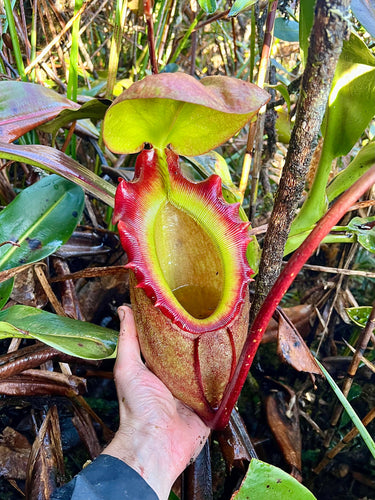
Nepenthes rajah is an absolutely iconic pitcher plant. Its egg-shaped pitchers with their huge opening, serrated peristome, and deep red color are instantly recognizable. In addition, it is one of the few Nepenthes with peltate leaves. The thick tendrils do not emerge at the end of the leaf, but a few centimeters before it.
It is only found on the slopes of Mt. Kinabalu and Mt. Tambuyukon at altitudes of 1500 to 2650 meters, thus belonging to the highland species.
It grows very large. The leaves can easily reach 60 cm in length, sometimes even up to 80 cm. It reaches a diameter of approximately 120 cm and a length of several meters. It grows slowly, typical of highland Nepenthes . The egg- to barrel-shaped pitchers grow up to 40 cm high and 20 cm wide. They have a volume of up to 4 liters and, in nature, hold up to 2.5 liters of digestive fluid.
Nepenthes rajah is certainly one of the best-known pitcher plants, especially since it has a reputation for being able to catch small mammals, such as rats. However, this is the exception, and in nature it usually only catches insects and other small arthropods. It is also one of several coprophagous Nepenthes species. Under the pitcher lid are glands that secrete a sugary nectar, which is eaten by mountain tree shrews ( Tupaia montana ). The pitchers are shaped in such a way that the shrews are forced to sit on them in such a way that their excrement falls into the pitcher. N. rajah also feeds on these nutrients.
Due to the required significant nighttime temperature drop and the sensitivity of this species, it should be reserved for experienced Nepenthes keepers.
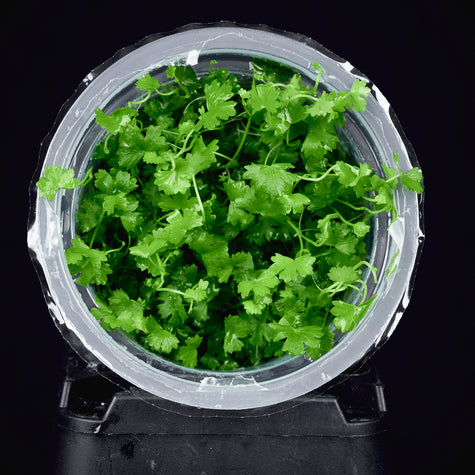
You will receive a well-hardened young plant, approximately 3 to 5cm in diameter in a 5.5cm pot (see picture 2 in the gallery).
Clone: BCP N2000, N2006
Nature photos: © Amon Horngacher (used with permission)
It is only found on the slopes of Mt. Kinabalu and Mt. Tambuyukon at altitudes of 1500 to 2650 meters, thus belonging to the highland species.
It grows very large. The leaves can easily reach 60 cm in length, sometimes even up to 80 cm. It reaches a diameter of approximately 120 cm and a length of several meters. It grows slowly, typical of highland Nepenthes . The egg- to barrel-shaped pitchers grow up to 40 cm high and 20 cm wide. They have a volume of up to 4 liters and, in nature, hold up to 2.5 liters of digestive fluid.
Nepenthes rajah is certainly one of the best-known pitcher plants, especially since it has a reputation for being able to catch small mammals, such as rats. However, this is the exception, and in nature it usually only catches insects and other small arthropods. It is also one of several coprophagous Nepenthes species. Under the pitcher lid are glands that secrete a sugary nectar, which is eaten by mountain tree shrews ( Tupaia montana ). The pitchers are shaped in such a way that the shrews are forced to sit on them in such a way that their excrement falls into the pitcher. N. rajah also feeds on these nutrients.
Due to the required significant nighttime temperature drop and the sensitivity of this species, it should be reserved for experienced Nepenthes keepers.
You will receive a well-hardened young plant, approximately 3 to 5cm in diameter in a 5.5cm pot (see picture 2 in the gallery).
Clone: BCP N2000, N2006
Nature photos: © Amon Horngacher (used with permission)
Care tips
Light & Location
Substrate & Repotting
Watering & Fertilizing
What makes us at Jungle Leaves special!


Welcome
Bring the Tropic to Your Home
Jungle Leaves is a team of 3 biologists who breed, propagate and sell extraordinary and unique plants from all over the world, also in cooperation with botanical gardens.