




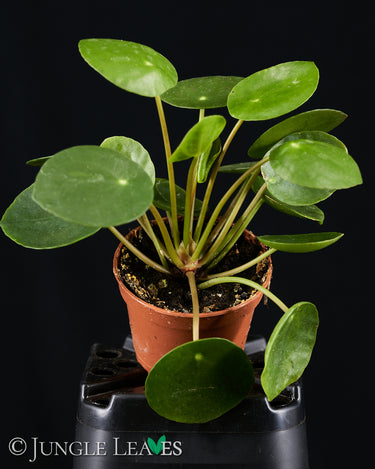


Pilea peperomioides (UFO plant / Chinese money tree)
3,99€ EUR
/
Tax included.
Shipping calculated at checkout.
Very easy-care Pilea from Southern China. Now a true classic and still an eye-catcher in any collection.
 Pilea peperomioides (UFO plant / Chinese money tree)
3,99€ EUR
/
Pilea peperomioides (UFO plant / Chinese money tree)
3,99€ EUR
/

Pilea peperomioides (UFO plant / Chinese money tree)
3,99€ EUR
/
Low Stock (5)
products.product.pickup_availability.unavailable
Description
Pilea peperomioides originates from the mountains around the city of Dali in the southern Chinese province of Yunnan. There, it grows at altitudes of 1500 to 3000 meters, usually in a very thin layer of humus directly on the rocks. It is therefore by no means a tropical plant from hot, humid rainforests, but rather a very hardy plant. It tolerates damp, cool temperatures well (possibly even frost) as well as hot, rather dry periods. This adaptability and robustness also make it such a popular houseplant.
It has a woody, sparsely branched trunk that can grow to about 30 to 50 cm tall and round, peeled, succulent leaves. Its flowers are small and inconspicuous. The male flowers are whitish, the female flowers somewhat larger and pale red.
Its origins were long a mystery. It was a popular houseplant for decades, but more or less unknown to the scientific community. In the attempt to unravel the mystery surrounding *P. peperomioides* , researchers eventually became desperate enough to appeal to the public. On January 9, 1983, an article was published in the British Sunday Telegraph, requesting that the Royal Botanic Gardens, Kew, be contacted if anyone had information about the plant's origins. Thanks to the tips received after the article, the origin of the "UFO plant" was finally clarified: it had arrived in Europe in 1946 via the Norwegian diplomat Agnar Espegren, who had to leave China and brought the plant with him. This trail then led first to Kunming (Yunnan) and finally to Dali. Expeditions into the mountains around Dali confirmed the plant's origin, and subsequently, herbarium specimens from 1906 and 1910 were discovered, in which the plant was first described and given its name.
A detailed description of the story surrounding P. peperomioides can be found here: http://www.wildchicken.com/nature/garden/ga008_a_chinese_puzzle.htm
It has a woody, sparsely branched trunk that can grow to about 30 to 50 cm tall and round, peeled, succulent leaves. Its flowers are small and inconspicuous. The male flowers are whitish, the female flowers somewhat larger and pale red.
Its origins were long a mystery. It was a popular houseplant for decades, but more or less unknown to the scientific community. In the attempt to unravel the mystery surrounding *P. peperomioides* , researchers eventually became desperate enough to appeal to the public. On January 9, 1983, an article was published in the British Sunday Telegraph, requesting that the Royal Botanic Gardens, Kew, be contacted if anyone had information about the plant's origins. Thanks to the tips received after the article, the origin of the "UFO plant" was finally clarified: it had arrived in Europe in 1946 via the Norwegian diplomat Agnar Espegren, who had to leave China and brought the plant with him. This trail then led first to Kunming (Yunnan) and finally to Dali. Expeditions into the mountains around Dali confirmed the plant's origin, and subsequently, herbarium specimens from 1906 and 1910 were discovered, in which the plant was first described and given its name.
A detailed description of the story surrounding P. peperomioides can be found here: http://www.wildchicken.com/nature/garden/ga008_a_chinese_puzzle.htm
Care tips
Light & Location
Substrate & Repotting
Watering & Fertilizing
What makes us at Jungle Leaves special!


Welcome
Bring the Tropic to Your Home
Jungle Leaves is a team of 3 biologists who breed, propagate and sell extraordinary and unique plants from all over the world, also in cooperation with botanical gardens.