



Wolffia arrhiza (Rootless Duckweed)
9,99€ EUR
/
Sold out
Tax included.
Shipping calculated at checkout.
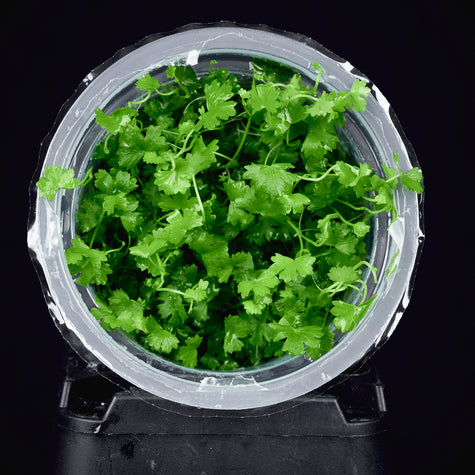
The world's smallest flowering plant! It is well-suited as a floating plant for nano tanks.
 Wolffia arrhiza (Rootless Duckweed)
9,99€ EUR
/
Wolffia arrhiza (Rootless Duckweed)
9,99€ EUR
/

Wolffia arrhiza (Rootless Duckweed)
9,99€ EUR
/
products.product.pickup_availability.unavailable
Description
Wolffia arrhiza is the smallest member of the Araceae family and also the smallest flowering plant in the world! It is widespread in the Old World and inhabits warm, stagnant, but not overly nutrient-rich waters in Europe, the Caucasus, parts of Africa, and Asia. In Germany, it is considered very rare.
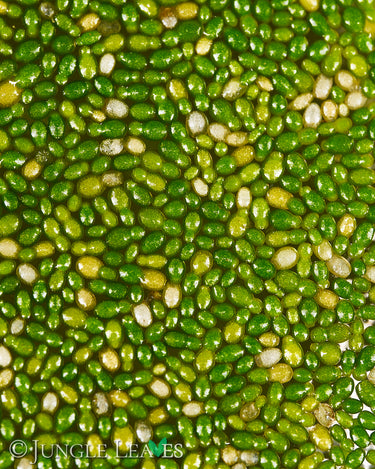
These tiny plants are only a maximum of 1.5 mm in size (usually even less than 1 mm!) and very simple in structure. They have no roots, leaves, or other plant organs and essentially consist of just a small ball of cells in a floating cushion. They can also flower . Their flowers consist of only a few cells, each forming a single style and a single stamen. Wolffia arrhiza usually reproduces by budding rather than by seed. In this process, a second ball of cells grows from the mother plant, and the two separate after some time. For overwintering, they produce turions, which contain little chlorophyll but a lot of starch (hence the yellow color!). These sink to the bottom of the water body in winter to survive the cold season.
Wolffia arrhiza is mixotrophic. Besides photosynthesis, it can also directly obtain carbon from the surrounding water, which simply diffuses into the tiny plant. It is very nutrient-rich. When dried, it consists of approximately 40% protein and 40% starch.
If you rub Wolffia arrhiza between your fingers, you immediately notice that it is much harder than other duckweeds and feels like fine sand. This makes it very easy to distinguish from other small duckweed species.
You will receive approximately 1-2 ml of plants in a 5 to 10 ml Eppendorf tube. This may sound like a small amount, but it's enough to cover a roughly 10 cm diameter dish with a layer of Wolffia ! We don't ship Wolffia in typical aquatic plant cups with lots of water and few plants, as this usually results in a big mess when unpacking.
Due to the long shipping time, shipping to the following countries is at your own risk: Estonia, Finland, Greece, Latvia, Lithuania, Sweden, Malta, Cyprus.
These tiny plants are only a maximum of 1.5 mm in size (usually even less than 1 mm!) and very simple in structure. They have no roots, leaves, or other plant organs and essentially consist of just a small ball of cells in a floating cushion. They can also flower . Their flowers consist of only a few cells, each forming a single style and a single stamen. Wolffia arrhiza usually reproduces by budding rather than by seed. In this process, a second ball of cells grows from the mother plant, and the two separate after some time. For overwintering, they produce turions, which contain little chlorophyll but a lot of starch (hence the yellow color!). These sink to the bottom of the water body in winter to survive the cold season.
Wolffia arrhiza is mixotrophic. Besides photosynthesis, it can also directly obtain carbon from the surrounding water, which simply diffuses into the tiny plant. It is very nutrient-rich. When dried, it consists of approximately 40% protein and 40% starch.
If you rub Wolffia arrhiza between your fingers, you immediately notice that it is much harder than other duckweeds and feels like fine sand. This makes it very easy to distinguish from other small duckweed species.
You will receive approximately 1-2 ml of plants in a 5 to 10 ml Eppendorf tube. This may sound like a small amount, but it's enough to cover a roughly 10 cm diameter dish with a layer of Wolffia ! We don't ship Wolffia in typical aquatic plant cups with lots of water and few plants, as this usually results in a big mess when unpacking.
Due to the long shipping time, shipping to the following countries is at your own risk: Estonia, Finland, Greece, Latvia, Lithuania, Sweden, Malta, Cyprus.
Care tips
Light & Location
Substrate & Repotting
Watering & Fertilizing
What makes us at Jungle Leaves special!


Welcome
Bring the Tropic to Your Home
Jungle Leaves is a team of 3 biologists who breed, propagate and sell extraordinary and unique plants from all over the world, also in cooperation with botanical gardens.