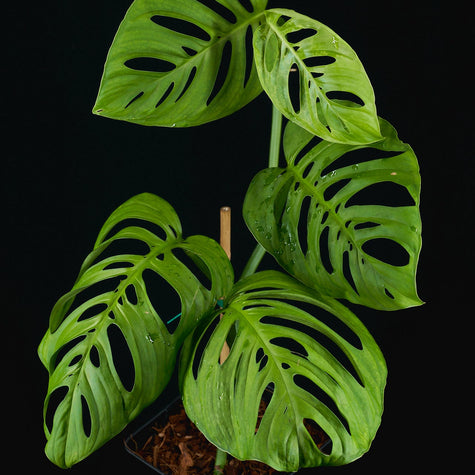
In spring, you can start watering as soon as the leaf begins to push out and unfurl significantly above the substrate. From now on, the plant should always be kept moderately moist and never allowed to dry out completely. It can be watered with medium-hard tap water. Regular flushing with soft water, such as rainwater, distilled water, or RO water, approximately every 3 months, is beneficial and prevents lime accumulation in the substrate.
Tuberous aroids grow quickly, which is why they need a lot of fertilizer. After sprouting during the growing season from approximately April to October, they should be fertilized weekly with a good complete fertilizer (N-P-K + trace elements) for houseplants, such as Wuxal Universal Fertilizer. For smaller species, we recommend adjusting the fertilizer to 500 µS/cm. For larger species, a conductivity of 800 µS/cm is acceptable. The conductivity can be determined with a TDS meter. In the autumn months, fertilization should be reduced, as the plants no longer receive enough light to utilize the nutrients. Watering is also reduced now to induce the dormancy phase. When the leaf begins to turn yellow, watering can be further reduced and eventually stopped completely. After about 2 weeks of dryness and once the leaf has died, the tubers can be removed from the pot. The daughter tubers can be broken off at the point where they attach to the mother tuber.
The tubers should be cleaned, and most species, after drying, should be stored in a cool (approx. 10 to 15 °C), dry place. In spring, they can be moved to a warmer location from March onwards. Fully tropical and dwarf species should be overwintered at 15 to 20 °C in moist sphagnum moss or in substrate. Once the first signs of growth appear, the tubers can be repotted and watered.
If they are only watered with soft water (e.g., when kept in a terrarium), a calcium and magnesium fertilizer (so-called CalMag fertilizer) should also be used.