



Dischidia platyphylla
15,99€ EUR
/
Sold out
Tax included.
Shipping calculated at checkout.
 Dischidia platyphylla
15,99€ EUR
/
Dischidia platyphylla
15,99€ EUR
/

Dischidia platyphylla
15,99€ EUR
/
products.product.pickup_availability.unavailable
Description
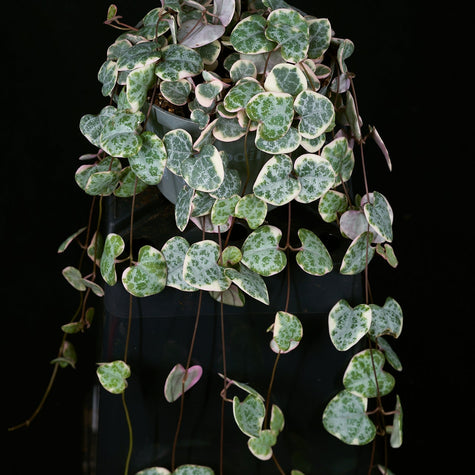
Dischidia platyphylla originates from the Philippines and French Polynesia.
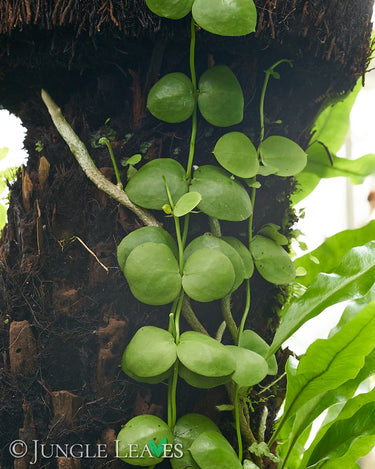
In nature, it grows epiphytically on larger trees, and older plants can form dense mats around the trunks. Its round, surprisingly thick leaves press tightly against the substrate, anchoring themselves with numerous aerial roots. The leaves then curl slightly upwards, creating a small cavity beneath them. This cavity retains moisture, providing the plant with water during extended dry periods. Trees densely covered with Dischidia platyphylla look somewhat as if they have a nasty, green rash.
Once Dischidia platyphylla reaches a certain size, it develops so-called "urn leaves." These are larger and usually don't lie flat against a support, but rather bend until they form a hollow sphere. Small, defensive ants then move into these urn leaves, protecting their new home and, consequently, the plant itself. Some roots also grow into the urn leaves. The plant uses these roots to absorb nutrients carried back to the nest by the ants. However, these nutrients are not, as is often claimed, ant excrement (ants are too clever to defecate in their own nest), but rather small amounts of dust and soil that the ants carry back to the nest on their feet. Dischidia platyphylla thus essentially forms its own flowerpot.
It can also be grown indoors as a hanging plant, but this way you don't really see its cool lifestyle and growth habit. We therefore strongly recommend giving it a piece of wood or cork for it to climb on ;)
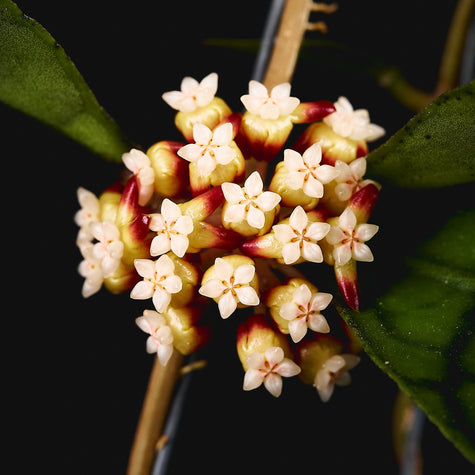
It blooms with small, pink/white flowers.
You will receive a plant in a 10 cm pot with several shoots (of course without ants).
In nature, it grows epiphytically on larger trees, and older plants can form dense mats around the trunks. Its round, surprisingly thick leaves press tightly against the substrate, anchoring themselves with numerous aerial roots. The leaves then curl slightly upwards, creating a small cavity beneath them. This cavity retains moisture, providing the plant with water during extended dry periods. Trees densely covered with Dischidia platyphylla look somewhat as if they have a nasty, green rash.
Once Dischidia platyphylla reaches a certain size, it develops so-called "urn leaves." These are larger and usually don't lie flat against a support, but rather bend until they form a hollow sphere. Small, defensive ants then move into these urn leaves, protecting their new home and, consequently, the plant itself. Some roots also grow into the urn leaves. The plant uses these roots to absorb nutrients carried back to the nest by the ants. However, these nutrients are not, as is often claimed, ant excrement (ants are too clever to defecate in their own nest), but rather small amounts of dust and soil that the ants carry back to the nest on their feet. Dischidia platyphylla thus essentially forms its own flowerpot.
It can also be grown indoors as a hanging plant, but this way you don't really see its cool lifestyle and growth habit. We therefore strongly recommend giving it a piece of wood or cork for it to climb on ;)
It blooms with small, pink/white flowers.
You will receive a plant in a 10 cm pot with several shoots (of course without ants).
Care tips
Light & Location
Substrate & Repotting
Watering & Fertilizing
What makes us at Jungle Leaves special!


Welcome
Bring the Tropic to Your Home
Jungle Leaves is a team of 3 biologists who breed, propagate and sell extraordinary and unique plants from all over the world, also in cooperation with botanical gardens.