



Goeppertia (Calathea) gandersii 'Velvet Glory'
 Goeppertia (Calathea) gandersii 'Velvet Glory'
14,99€ EUR
/

products.product.pickup_availability.unavailable
Description
Goeppertia gandersii (formerly Calathea gandersii) is native to the provinces of Napo and Orellana in Ecuador.
It grows in the shady undergrowth of lowland rainforests at altitudes of 180 to 240 metres above sea level. Like all Goeppertia (formerly Calathea), it has a rhizome (underground stem), which it uses to spread by creeping. New leaves form from the rhizome at short intervals. Only these are visible above ground. What look like small stems are actually the petioles or leaf sheaths, which support one another.
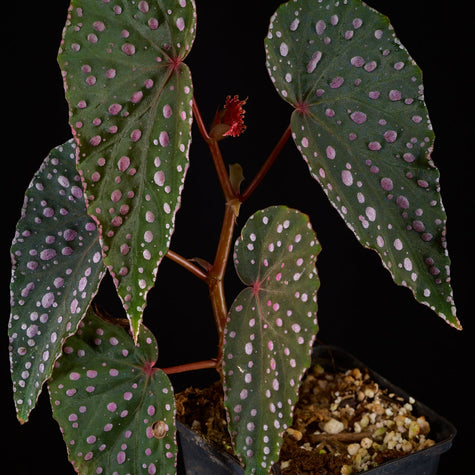
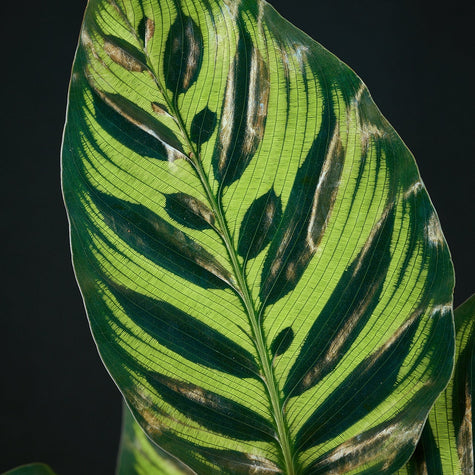
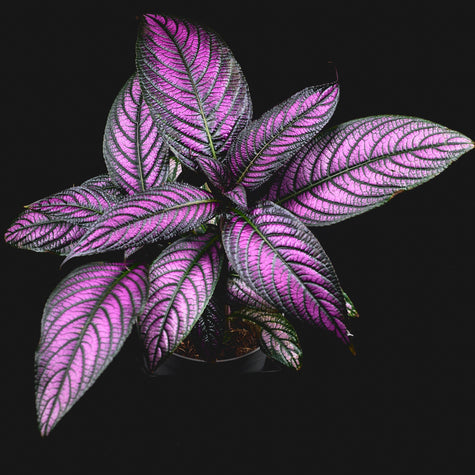
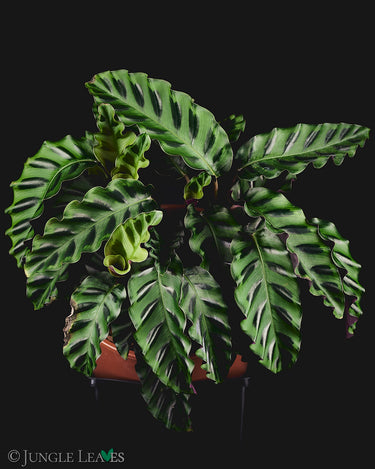
The species grows very compactly and does not spread rapidly. Over time, it forms a dense clump. It is one of the smaller members of the genus and grows to a height of approximately 40 cm, with leaves 30 cm long but only 8 to 12 cm wide. The leaves are dark green in colour, with a row of black spots to the left and right of the midrib. From underneath, the leaves are carmine red. In addition to their beautiful pattern, the elongated leaves also have strongly undulating (wavy) margins.
The pattern on the leaves serves to conceal the size of the leaf from phytophagous insects (e.g. butterflies) and other herbivores. The markings and contrast allow it to blend into the complex, shadowy background of the rainforest. Only when viewed in isolation, for example, as a houseplant, do the leaves appear so striking. In the wild, they provide perfect camouflage amongst the undergrowth.
In our opinion, it is one of the most beautiful members of its genus! It is closely related to the better-known Goeppertia insignis, but remains smaller, more compact and has significantly darker and more deeply corrugated leaves.
The arrowroot family is also known in English as ‘prayer plants’, due to the mobility of their leaves, which they orient towards the light during the day and fold upwards at night, like hands in prayer. This probably also serves to protect them from being eaten.
To enable this rapid movement (folding up in the evening takes only about 30 minutes), they have a leaf joint, known as the ‘pulvinus’, in the lower part of the leaf, which contains specialised cells that alter the shape of the joint by changing the cell pressure, thereby controlling the orientation of the leaf.
Care tips
Light & Location
Substrate & Repotting
Watering & Fertilizing


Welcome
Bring the Tropic to Your Home
Jungle Leaves is a team of 3 biologists who breed, propagate and sell extraordinary and unique plants from all over the world, also in cooperation with botanical gardens.