

Microsorum siamense
69,99€ EUR
/
Sold out
Tax included.
Shipping calculated at checkout.
 Microsorum siamense
69,99€ EUR
/
Microsorum siamense
69,99€ EUR
/

Microsorum siamense
69,99€ EUR
/
products.product.pickup_availability.unavailable
Description
- Origin: Thailand
- Care: Easy / Medium / Advanced
- Suitable as a houseplant?: Yes / Limited / No
- Suitable locations: Terrarium
- Special features: Very slow growing but one of the most beautiful of all ferns.
[porto_content_box border_top_color="#1e764d" border_radius="2" border_top_width="2" align="left"]
[expand Title=" Details about the plant "]
Microsorum siamense was only described as a new species in 2006 (initially as Microsorum siamensis , which is grammatically incorrect and was later corrected). This small fern originates from the province of Yala in the far south of Thailand. It has an apparently relatively small distribution area and has so far only been collected from one location in the region. It grows lithophytically in crevices of limestone rocks.
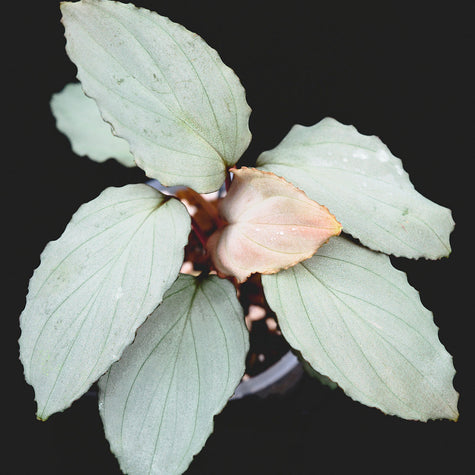
*M. siamense* grows with a compact, climbing rhizome. The leaves are elliptical, sometimes with a slightly elongated tip, and reach a length of about 15 to 20 cm and a width of 5 to 6 cm. They are noticeably stiff but not particularly thickened. The upper surface of the leaves is a deep metallic blue and covered with numerous white spots. These white spots are called hydathodes, or water slits, through which the fern can actively excrete water in very high humidity. Unlike the blue iridescence of begonias, which can only be observed in the dark when a flashlight or strobe light shines on the leaves from a specific angle, the blue color of *M. siamense* is always visible. Even wetting the leaves with water does not make the color disappear; on the contrary, it tends to intensify it. The nanostructures responsible for the coloration are different from those found in begonias. Further details can be found in this blog post .
The coloration likely serves a different function than the iridescence of most other blue plants. It is thought that in M. siamense, it acts as sun protection rather than a method of capturing extra light. While this fern does grow in the shady undergrowth of a rainforest, it is not as dense as one might expect. Individual patches of sunlight frequently reach the ground, and these are approximately 1,000 to 10,000 times brighter than the ambient light that otherwise reaches the forest floor. The reflective blue coloration of M. siamense is thought to protect against precisely this sudden, intense light.
At first glance , Microsorum siamense resembles the Thai oil fern ( Microsorum thailandicum ) , but the two ferns may not be closely related within the very large genus Microsorum . M. siamense has much broader and thinner leaves than M. thailandicum , and the hydathodes on the upper leaf surface are also absent in M. thailandicum .
For more details: Here is the species description of M. siamense , which can be downloaded for free as a PDF.
[/expand]
[/porto_content_box]
You will receive a well-rooted cutting with new growth in a 7cm pot.
Please note: These sections are currently pushing out new leaves, which are still very delicate. Please handle them with extra care when unpacking, otherwise they can break easily!
Care tips
Light & Location
Substrate & Repotting
Watering & Fertilizing
What makes us at Jungle Leaves special!


Welcome
Bring the Tropic to Your Home
Jungle Leaves is a team of 3 biologists who breed, propagate and sell extraordinary and unique plants from all over the world, also in cooperation with botanical gardens.