



Monstera obliqua 'Peru'
 Monstera obliqua 'Peru'
14,99€ EUR
/
Monstera obliqua 'Peru'
14,99€ EUR
/

products.product.pickup_availability.unavailable
Description
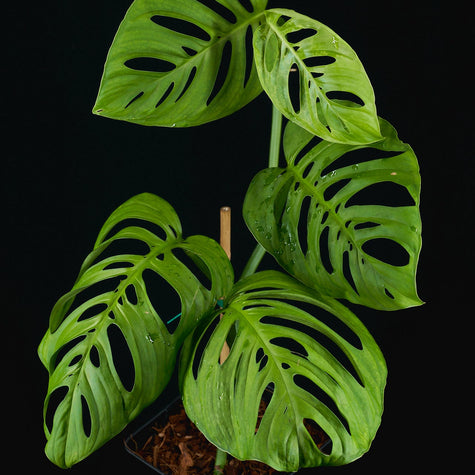
Monstera obliqua is widespread, occurring from southern Mexico to Brazil, Ecuador, Bolivia, and Peru. Most findings come from the southern end of its range, in Peru and Bolivia.
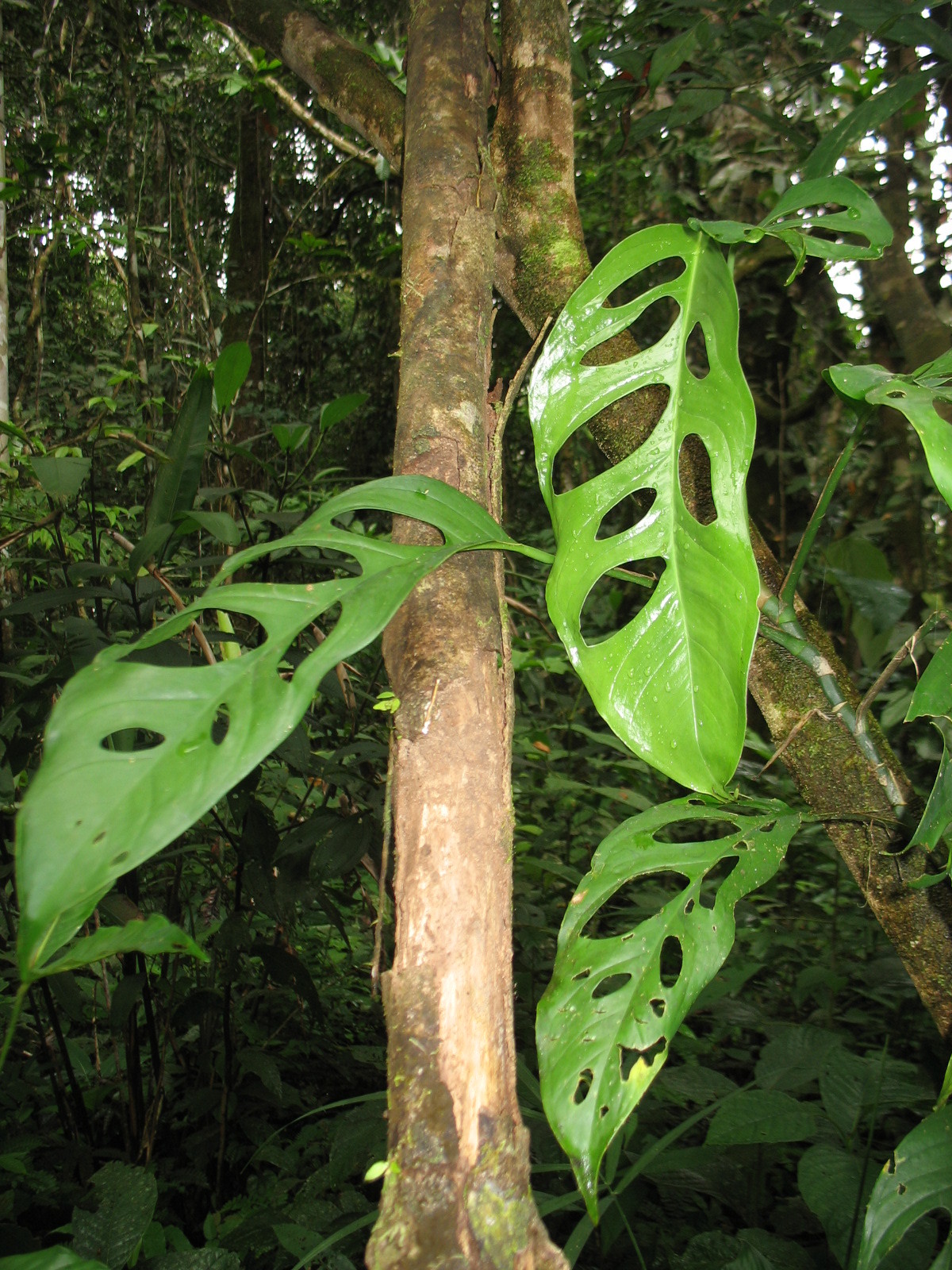
Like many other members of its genus with large distributions, Monstera obliqua shows very different leaf morphologies in different locations. There are forms with completely unfenestrated leaves, forms with moderately fenestrated leaves, and even the form offered here, which produces leaves that consist almost entirely of holes! However, one and the same plant always maintains "its" form and does not change its appearance.
This great variance, however, raises the question of why these very different-looking plants should all belong to the same species. If one only looks at the extreme examples at both ends of this morphological spectrum, it seems clear that they are very different plants. In nature and at the population level, however, one will find that there are unfortunately no such clear distinctions. All forms, from "only holes" to "no holes," merge fluidly depending on the habitat. In the drier areas of its range, the more robust, unperforated forms dominate. In very humid areas, one finds more of the forms with large holes (see here the comment on the herbarium sheet "bosque muy humedo tropical" = "very humid tropical forest").
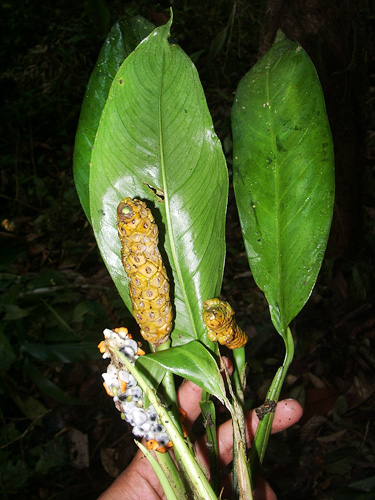
Because of this great variety of forms, Monstera obliqua is not identified by botanists by leaf fenestrations, but mainly by the inflorescence and fruits, which differ greatly from the otherwise quite similar Monstera adansonii! In the original species description from 1844, holes in the leaf are not mentioned at all. This is still valid today, as the species name is still botanically accepted. However, there is a typical leaf characteristic that allows even non-flowering specimens to be identified quite well: the leaves are "oblique." One side is always larger than the other, and in mature plants, one can also see at the base of the leaf that one side has a distinct "lobe" while the other does not. It is also named after this characteristic, "obliqua" is Latin for "oblique." Unfortunately, this characteristic does not apply to all populations, but only to most. A reliable identification is therefore only possible through the flowers and fruits.
This great variance has unfortunately also led to the repeated assertion that there is only "one" true M. obliqua. This claim can be found in numerous blogs, forum posts, and even in shops. The adventurous claim is even made that the "true" M. obliqua has only been found a few times in nature at all. This is definitely not correct and simply nonsense. The species is widespread and very variable. If you wish, you can get an overview here of several hundred herbarium specimens of Monstera obliqua, all of which have been identified by botanists, including Thomas B. Croat, probably the greatest authority on South American aroids.
The form we offer here shows probably the most extreme expression of fenestration in the entire plant kingdom. The lamina of the leaf is reduced to an absolute minimum, especially in mature specimens. It probably originates from very humid lowland rainforests at the foot of the Andes in Peru and is adapted to the conditions there. Accordingly, this form of M. obliqua is only conditionally suitable as a houseplant and should rather be kept in a terrarium or plant cabinet.
You will receive a strong young plant in a 6 cm pot, approx. 15 to 20 cm high.
Care tips
Light & Location
Substrate & Repotting
Watering & Fertilizing


Welcome
Bring the Tropic to Your Home
Jungle Leaves is a team of 3 biologists who breed, propagate and sell extraordinary and unique plants from all over the world, also in cooperation with botanical gardens.