

Phyllagathis rotundifolia
29,99€ EUR
/
Sold out
Tax included.
Shipping calculated at checkout.
A spectacular blackmouth plant from Indonesia and Malaysia with large, iridescent blue leaves. An absolute rarity!
 Phyllagathis rotundifolia
29,99€ EUR
/
Phyllagathis rotundifolia
29,99€ EUR
/

Phyllagathis rotundifolia
29,99€ EUR
/
products.product.pickup_availability.unavailable
Description
- Origin: Indonesia, Malaysia
- Care: Easy / Medium / Advanced
- Suitable as a houseplant?: Yes / Limited / No
- Suitable locations: terrarium, plant display case
- Special features: Perhaps the most impressive iridescent plant in the world. It grows slowly and becomes very large.
[porto_content_box border_top_color="#1e764d" border_radius="2" border_top_width="2" align="left"]
[expand Title=" Details about the plant "]
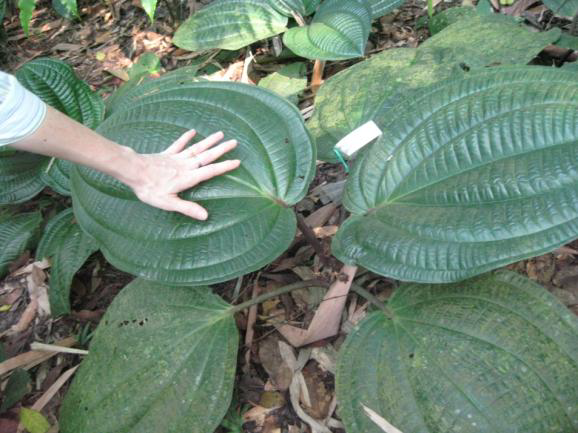
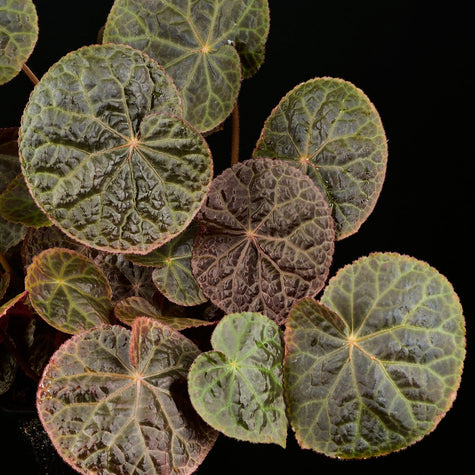
Phyllagathis rotundifolia is a large-growing member of the Melastomataceae family from the Malaysian Peninsula (Indonesia and Malaysia). It grows terrestrially in shady, permanently damp locations in the rainforest. The leaves have the characteristic veining of Melastomataceae, giving them a quilted surface. They are round and only slightly pointed, reaching a diameter of approximately 30 to 40 cm. The plant itself can reach a diameter of 80 to 100 cm. The closely related (but less spectacularly colored) speciesPhyllagathis praetermissa grows considerably larger! The leaves have a few stiff hairs on their upper surface.
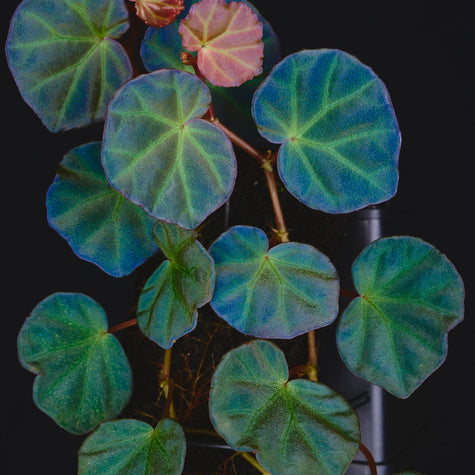
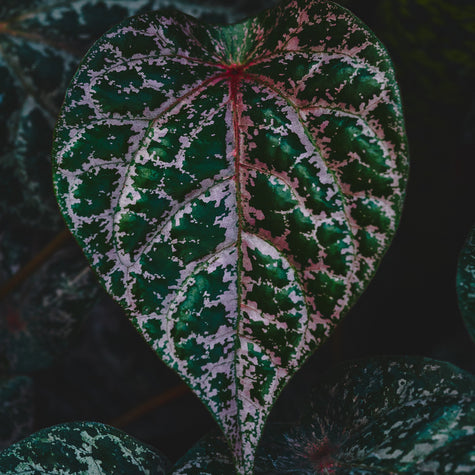
The most striking feature of P. rotundifolia is, of course, the blue, metallic color of its leaves. As with most iridescent plants, this coloration is a side effect of adaptation to low light. It only develops when the plant grows in shady conditions. Otherwise, the leaves are more green. In the image gallery, I've added some photos of our large mother plant, showing the different color variations at different times of the year (all taken with a mobile phone, as the large plants don't fit in our camera box). In our greenhouse, the mother plants usually look their most spectacular in the middle of winter. In summer, they tend to revert to green, even though we place them in a shady corner. Fresh leaves are always initially green. The undersides of the leaves are faintly reddish. The stem and leaf stalks are red.
Phyllagathis rotundifolia produces numerous so-called pearl bodies on all parts of the plant, but especially on the undersides of the leaves. These are nutrient-rich, solid secretions that look like small pearls and are eaten by ants in nature. The ants specifically seek out plants with pearl bodies and defend them—a classic example of symbiosis. Pearl bodies should be removed regularly, as they can accumulate on the plant (without the ants) and become moldy.
The flower heads consist of dozens of bright pink flowers with white stamens, standing very close together.
Phyllagathis rotundifolia grows rather slowly and, despite its impressive final size, can be cultivated in a terrarium for years. A fully grown specimen will hardly fit in a standard-sized terrarium and is more suited to a grow tent or greenhouse. However, the plant can be kept smaller by pruning.
For me personally, one of my favorite plants, which I had on my wish list for many years.
[/expand]
[/porto_content_box]
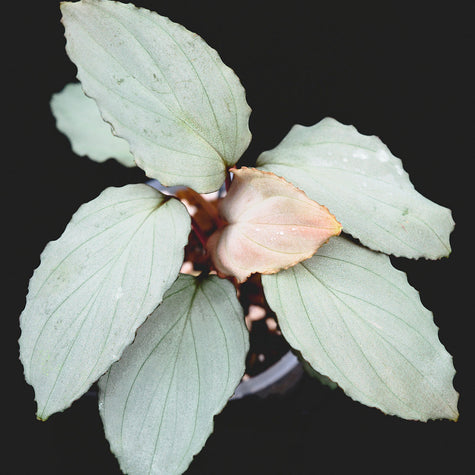
You will receive a young plant in a 9cm pot, with 2 to 4 leaves (3rd and 4th pictures). We grow the young plants under (relatively) strong light to encourage faster growth. Therefore, they are not (yet) particularly blue.
Care tips
Light & Location
Substrate & Repotting
Watering & Fertilizing
What makes us at Jungle Leaves special!


Welcome
Bring the Tropic to Your Home
Jungle Leaves is a team of 3 biologists who breed, propagate and sell extraordinary and unique plants from all over the world, also in cooperation with botanical gardens.