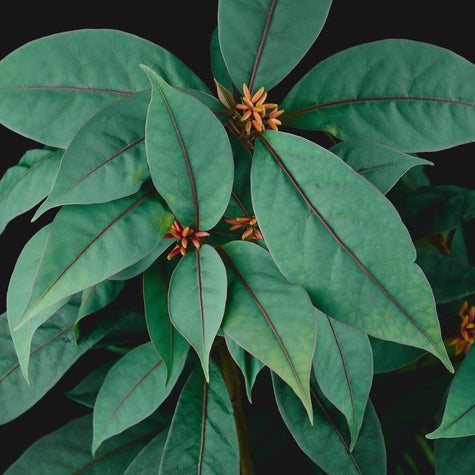
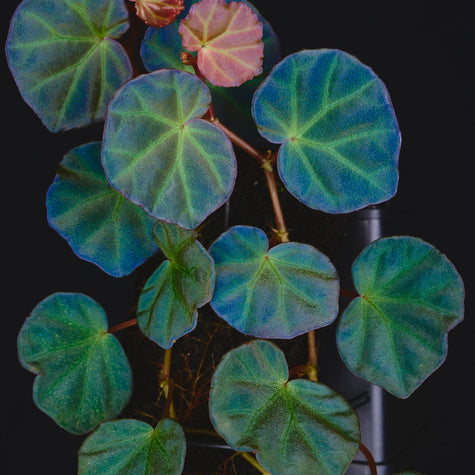
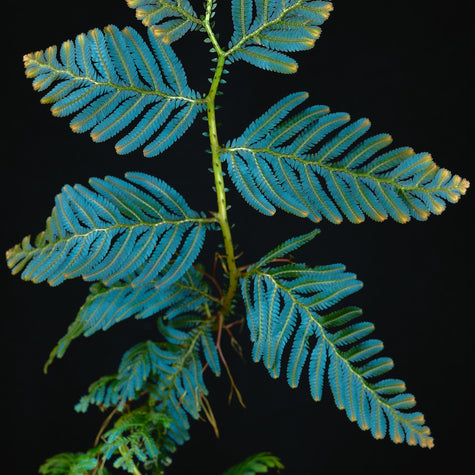
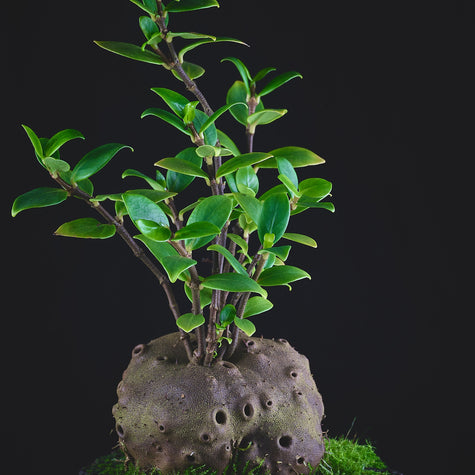


The second part of this blog series on lighting focuses on practical comparisons and examples.
Are lamps really necessary?
Similar to us, our plants also have certain basic needs that must be met in quality and quantity to enable healthy growth. In addition to the right substrate, humidity, and nutrients, this primarily includes the right light. Plants are photoautotrophic organisms, meaning they meet their energy needs exclusively through captured light. If there is not enough light, growth stagnates, and the plant can survive for a while on stored starch, for example, until it eventually starves.
So, we must ensure that the light available to our plants can permanently cover their energy needs. Diffuse room lighting is usually not sufficient for this; even what appears bright to our eyes is often not enough for plant growth.
This article will discuss how much we really need, how to save costs, and what else to consider regarding the quality of the plant lamp.

How much light do my plants need?
Lamps should be chosen with adequate dimensions, but they also cost money to purchase and operate. So, you will often find a compromise somewhere in between. The actual light requirement depends on the plants being cultivated and is most easily expressed in Lux. Lux is composed of the SI units Lumen/square meter and can therefore be calculated very easily. Lumen is always a total amount of emitted light, in this case, from our artificial light sources, and is indicated on the packaging.
Example:
The shelf of a Milsbo display cabinet (66 x 36 cm) is to be illuminated with a lamp providing 1400 lumens: 1400 lumens / 0.24 m2 = 5830 Lux
But is that a lot or a little? A few examples:
Sun on a clear sky: > 100,000 Lux
Overcast sky in summer: 10-20,000 Lux
Overcast winter day: ~2-5,000 Lux
Tropical rainforest undergrowth: ~2,000 Lux*
Office lighting: 500 Lux
Moonlight: approx. 0.1 Lux
*according to Becek & Salim 2017
Unshaded solar radiation near the equator can reach up to 200k Lux (own measurement). However, we will never have to imitate such extreme values, as even plants adapted to strong light cannot utilize more than ~50k Lux. For most of our typical houseplants like Alocasia, Philodendron, or Begonia, significantly lower values are sufficient. In fact, with constantly so much light, they would burn or bleach. The following illustration provides a concrete overview. Fig. 1: Classification of various well-known houseplants into light requirement zones. The placements are intended more as minimums; some plants also thrive flexibly over large areas.
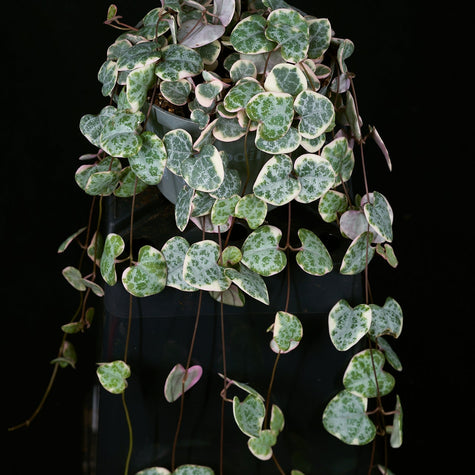
The ~5000 Lux from the example calculation are therefore in the middle range and are well suited for many common houseplants. For anthuriums or begonias, for example, it could be a little less, and for string of hearts or desert roses, more. Of course, this representation can only serve as a guideline and is often intended as a minimum value. The necessary amount of light also depends on the spectrum and the duration of illumination; with a well-balanced lamp spectrum, some Lux can be saved. With a short 8-hour photoperiod, on the other hand, comparatively more light intensity is necessary than with 12 hours.
The following illustration from our greenhouse shows that natural sunlight in our latitudes is often insufficient not only in intensity but also in duration. The intensity of solar radiation was recorded on an average day in November 2023 behind double glazing (similar to window glass) on a horizontal surface without shading. Significant illumination occurs from about 8 a.m. and sometimes still reaches over 5000 Lux at noon, but after 3 p.m. it is practically night for the plants. Plant lamps can well supplement the missing intensity and/or duration.
Fig. 2: Solar radiation in Lux in our greenhouse in Herten, West Germany, on a slightly cloudy day in November 2023. Measurement under double glass, horizontal surface without shading.
Practical tip: If you don't want to buy an expensive lux meter to measure light intensity at home, you can also use your smartphone. For all operating systems, there are "Luxmeter" apps in the app stores that use the front sensor for brightness measurements. This is of course not very accurate, but more reliable than the human eye and sufficient for rough classifications.
What light do plants need?
For millions of years, plants have only had one light source - the sun. Accordingly, evolution has ensured that precisely this light can be used as efficiently as possible. So, you can generally do little wrong by using artificial lighting that is as sun-like as possible, i.e., white light. However, due to various effects of the absorption properties of pigments in plant tissue and the optoelectronics for imitating the desired light, many possibilities also arise for optimizing the spectrum.
Fig. 3: Comparison of the photosynthetic action spectrum according to McCree, K. J., 1972 (Modified) with marking of PAR radiation and weighting of Lumen
The graphical representation of the light source's spectrum is necessary for evaluation. It simply describes the brightness of the light source in different colors, given in nanometers of the wavelength of electromagnetic radiation. Photosynthesis occurs in the range of approx. 400 - 700 nm (PAR), which actually corresponds quite closely to our visual perception. Shortwave, i.e., <400 nm, is UV radiation, which has no direct significance for photosynthesis but can certainly support the formation of secondary metabolites. In plants, these can be, for example, protective pigments (anthocyanins) that color leaves reddish. However, this is usually dispensed with in private cultivation. After UV comes violet and then blue radiation up to approx. 500 nm. Blue light is essential for photosynthesis; chlorophyll has absorption maxima at approx. 430 and 450 nm. Between 500 and 600 nm is green to yellow; this range is also important for photosynthesis. Although plants appear green because a somewhat larger portion of green light is reflected, carotenoids and other so-called antenna pigments of the light-harvesting complex of higher plants nevertheless utilize most of the radiation. Green radiation also penetrates deeper through the upper leaf layer (Bugbee, B., 2016). Above 600 nm wavelength comes orange and above 650 nm red; this radiation is also essential for photosynthesis; chlorophyll again has absorption maxima at approx. 640 and 660 nm. Above 700 nm, near-infrared radiation begins; we can no longer see this light. It is also no longer absorbed by chlorophyll, but this light has important functions (more on this later).
What light do LED lamps produce?
LEDs are currently significantly superior to all other artificial light sources in terms of efficiency and light quality; other technologies such as HID, fluorescent lamps, etc., no longer need to be considered for grow lights. LEDs initially always emit only monochromatic, i.e., single-color light with a bandwidth of approx. 10 nm, e.g., 660 nm +-5 nm. This is used directly for blue and red to provide the most light at the strongest absorption peaks of plant pigments.
If you stick to this, you get the violet light known from many "plant lamps." This looked very characteristic and was therefore a simple marketing argument that plants needed such lamps. However, this has been better known at least since the 1970s with McCree's measurements. The information still persists.
White LEDs generate light by converting blue light of 450 nm into all other wavelengths using a yellow phosphor layer. The quality of the blue base LED and the phosphor mixture determines values such as efficiency, color temperature, and color rendering (CRI). Fig. 4: Spectrum of the Jungle Lux Growlight in the range of 400 - 800 nm
Natural, neutral light has a color temperature of approx. 4000 Kelvin. This appears neither yellowish nor too cool white and is also an ideal average for plants. This value is achieved by balancing the total amount of all red and blue light components. 3000K or 5000K are also good alternatives.
Another quality feature is color rendering; a high CRI value of up to 100 indicates high sun-likeness. Gaps in the spectrum lead to deductions in CRI; colors are then underrepresented. Cheap lamps often have values around 70 CRI; for room and plant lighting, values around 80 are sufficient. Even better values >90 are only relevant for photography, for example.
Pure white LEDs can already be sufficient as plant lamps. The blue peak is usually sufficiently strong, but in the red range, intensity is missing in the longer wavelength range >650 nm. This is due to technical reasons, as no phosphor has yet been developed that would have its maximum in that range. To solve this, some plant lamps have additional red LEDs in addition to the white ones, which thus increase efficiency. This can be clearly seen in the spectrum.
Some high-end grow lights also have individual far-red diodes installed, which stimulate the phytochrome system of plants in the range above 700 nm, which brings further positive effects.
Efficiency and power consumption
In addition to the quality of the light, we naturally also want to discuss the light intensity already mentioned. The more efficient the lamp operates, the less power we have to consume.
Depending on the manufacturer, different values may be given. The most well-known is Lumen, which also forms the basic unit for Lux. This is usually a good guide, but it is a heavily weighted value, as shown in Fig. 3. Lumen is oriented towards the sensitivity of the human eye, which is highest at 555 nm. Here, even small intensities result in large lumen values, although this radiation is actually somewhat less efficient for plants. However, if similar light sources are compared, lumens/lux can still be used for comparison. Sometimes, however, manufacturers cheat on brightness by adding extra green for high lumen values.
The efficiency of the lamp is given in lumens/watt.
Example: Jungle Lux 1400 lumens / 9 watts = 155 lumens/W (incl. power supply)
If an external power supply is required for operation, you have to add about 10% to the watts.
(The consumption of Far Red or UV diodes would theoretically have to be deducted from the watts, but that makes it a bit too complicated)
A more independent value is the PAR value, which is given as µmol/s (total light like lumen) or µmol/Joule (efficiency like lumen/W), but is missing as an indication for many lamps. Although the units of the values look quite abstract, they have similar statements to the more familiar lumens, but from the perspective of plants. Unfortunately, this value also does not allow any conclusion to be drawn about the quality of the spectrum. For example, a purely red lamp can have a very high PAR value but is useless if the other spectra are missing. With a known, balanced spectrum, the PAR value is a meaningful indication.
The so-called PPFD value can hardly be interpreted for efficiency, as it depends on the measuring distance and, above all, on the housing of the lamp.
From the example of the Jungle Lux, the 1400 lumens correspond to approximately 21 µmol/s, and the 155 lumens/W correspond to approximately 2.2 µmol/J. Higher values are better, lower values are worse. Neither UV nor infrared values are included here.
Practical examples
In fact, there are extreme differences in the efficiency of lamps available on the market. Some models currently in production don't even reach 50 lumens/W, which is less than old T5 or T8 tubes. It's incomprehensible how this comes about...
The best high-end models achieve up to 200 lumens/W, so within LED technology, there are differences by a factor of 4 in how much electricity can be saved. A good 10 W LED lamp can emit just as much usable light as an unsuitable 40 W LED lamp.
At 12h a day, this means:
30W * 12 * 365 = 131,400W per year;
131.4 kWh * 0.4€/kWh = 52.56€
Replacing this one example lamp therefore saves over 50€ every year at current electricity costs.
Table 1: Comparison of some plant lamps by efficiency (performance data includes power supply)
| Model | Price (11.23) |
Power (W) | Lumen | Efficiency (Lumen/W) | PPF (μmol/s) | Efficiency (μmol/J) | Note |
| Sanlight Flex II | 40.20 + 22.08 | 11 | ~1700? | 160? | 25 | 2.30 | Without Red/Far Red |
| Jungle Lux 60 | 34.99 | 8 | 1300 | 150 | 19 | 2.30 | With Red/Far Red |
| Jungle Lux Spot |
24.99 | 12 | 1600 | 135 | 23 | 1.95 | With Red/Far Red |
| Philips LED Reflector 2700K | 7.99 | 6 | 640 | 106 | - | - | Good household spot |
| Eheim classic LED daylight | 49.85 | 7.7 | 810 | 105 | - | - | Aquarium light |
| Sansi | 29.99 | 36 | 3250 | 90 | 66 | 1.83 | Strong heat development |
| Baltimore LED Spotlight | 9.95 | 15 | 1180 | 52 | - | - | Simple construction spotlight |
| Chihiros WRGB II Slim |
149.99 | 23 | 1200 | 77 | - | - | Popular aquarium lamp |
| DOOA Magnet Light G | 79.99 | 11 | 475 | 43 | - | - | Why? |
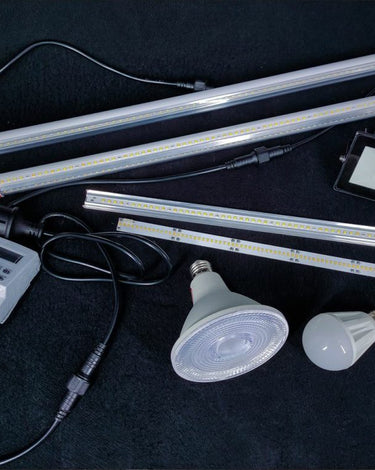
The Sanlight and Jungle Lux from the examples are linear lights, which have a high beam angle and therefore provide very even illumination even at low distances. The distance to the plants should be between approx. 20-100 cm. Areas of application include display cases, shelves, grow tents, terrariums, or aquariums.
On the other hand, lamps like the Sansi or the Jungle Lux Spot are spotlights that emit light in a concentrated beam from a rather point-shaped source. They are used to illuminate plants that are further away, but illuminate a somewhat smaller area. Typical distances, depending on the power, are between 50-200 cm.
Lifespan
LEDs can last a very long time with proper thermal management. That's why the chips are usually permanently installed and not replaceable like light bulbs. A lifespan of 10 years at 12 hours a day is quite realistic, and even then, the lamp is not defective but has only lost some of its luminous intensity.
However, this only works with sufficiently dimensioned heat sinks in the lamp. Some manufacturers cut corners here, sometimes a heat sink is completely missing or designed as a plastic dummy (a rogue who thinks evil). Such models lose a lot of light intensity after only a few months or fail completely.
Ideally, a lamp should be able to be touched by hand even during continuous operation without burning oneself. For small spots with high power, the temperature on the heat sink may also exceed 50°C, but the cooler, the better.
Far Red and Morphogenesis
Photomorphogenesis describes the light-dependent shape of plants. In addition to chlorophyll for energy production, all higher plants have other, lesser-known light-harvesting pigments that can provide them with information about light quality. Thus, plants practically "see" their surroundings and adapt their growth accordingly.
One of the most important of these systems is the phytochrome complex, which specifically perceives radiation around 730 nm wavelength (far red) and relates it to the available red radiation (660 nm) (Durazzo, B. D., 2021).
But why does a plant benefit from being able to detect near-infrared radiation?
The answer could be particularly important for our jungle darlings like Alocasia, Philodendron, Begonia, or Selaginella.
These plants usually do not occur in direct sunlight in nature, but on the jungle floor under a dense canopy. This filters out a large part of the red and blue radiation before the light reaches the plants further down. The light still available is then shifted towards green. How strongly the plants are shaded is important information, because they depend on it for e.g. leaf size or chlorophyll synthesis (Stutte, G. W., 2009). In heavy shade, large, dark leaves must capture as much residual light as possible, while in abundant natural sunlight, they would quickly burn.
Plants use Far Red light precisely for this, because it penetrates the canopy to a greater extent than normal red light. If the proportion of Far Red to Red is significantly higher than normal, the plant believes it is being shaded by others and grows differently accordingly.
For lettuce (Lactuca sativa), adding small amounts of Far Red to the illumination has already increased biomass by over 50%, with otherwise the same light intensity (Wenqing et al. 2021).
Of course, our blue iridescent plants, which we covered in this blog article, also come from the shaded areas of tropical rainforests and tend to receive a particularly large amount of Far Red radiation in these locations. A strengthening effect of Far Red radiation on blue coloration would therefore be expected. In fact, this has already been shown for Selaginella uncinata at approx. 1000 lux and an R:FR ratio of 0.35 (Hebant & Lee, 1984) and is thus also to be expected for other iridescent plants.
Fig. 5: Selaginella uncinata shows blue iridescence as an adaptation to shaded locations
Summary
- Know the light requirements of the plants being cared for (e.g., from Fig. 1)
- Measure existing setups with a lux meter (also available as a phone app)
- Select the amount of light needed, e.g., in lumens per area and light requirement
- Comparing is doubly worthwhile when buying lamps (examples in Table 1)
- Choose LED lamps with white light and high efficiency >120 lumens/W
- Plant-optimized spectra with high CRI, extra red, and far red have further positive effects
All images in this post, unless otherwise specified, and post text: © Nils Schmitz