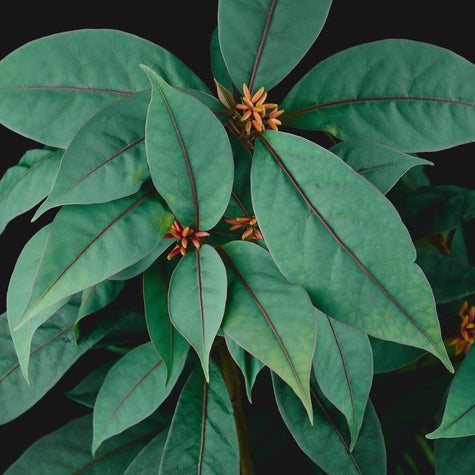
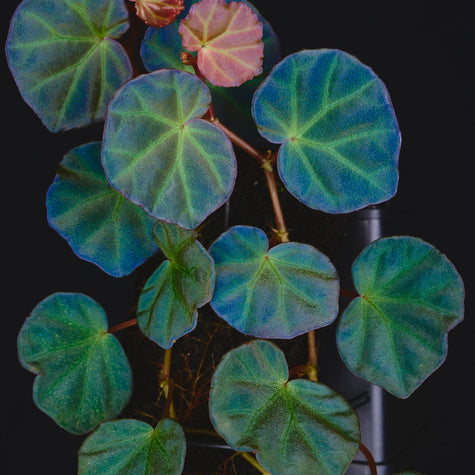
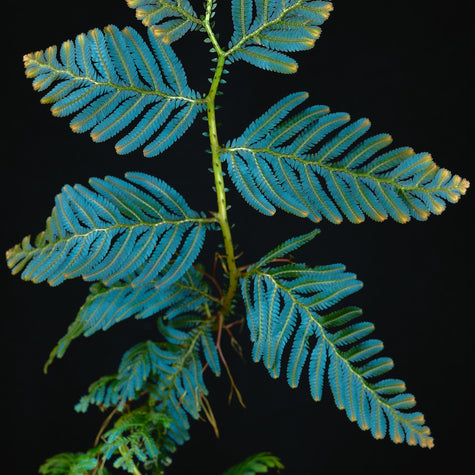
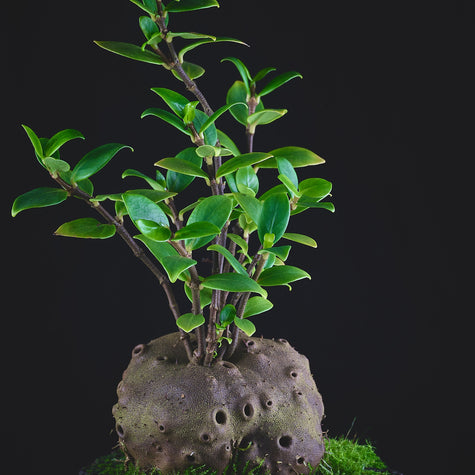


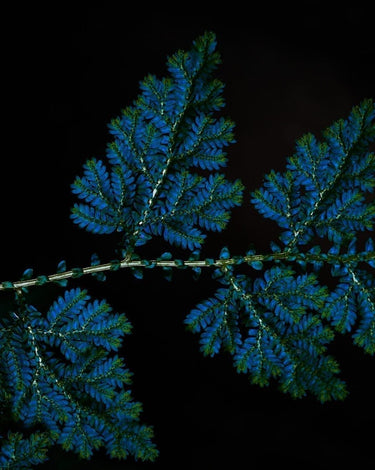
1. How? What? Blue Plants?
It must have been sometime in the autumn of 2014 when I first saw a picture of a Begonia pavonina, the "Peacock Begonia." It was in an eBay listing for this plant and, according to the description, it was supposed to "glow in the dark."
Anyone who frequently searches for plants on eBay is probably familiar with the numerous fraudulent listings featuring ridiculously poorly edited pictures showing all sorts of rainbow-colored or blue plants. At the time, this begonia looked just as fake to me, and then this plant was also supposed to serve as a nightlight? Believe it if you want. So I ignored it and scrolled on...
...and less than five minutes later, I was back. Somehow, this didn't look like a fake. Are there really plants with blue leaves? Do they really glow?
And that's how my fascination with blue iridescent plants began.
In the meantime, I have a small but steadily growing collection of about 30 plant species with one form or another of blue iridescence (more on that later), and a larger and much faster growing wish list of other specimens.
I also know by now that these plants naturally don't glow at night, and that it's very difficult to convey in pictures what this unique effect really looks like "in real life."
In this blog post, I want to introduce some specimens from this very diverse group of plants, explain the background and possible function of their metallic appearance (or at least try to), and present the current state of research on this phenomenon.
2. Are these plants really blue?
First, let's clarify what this effect really looks like in reality:
What is edited?
What do I really see when I stand in front of it?
And why do the pictures often look so fake?
To the first question, "What is edited?", the answer is very simple: almost everything.
Even professional cameras have real trouble reproducing the effect true to reality. All pictures in this blog post, and also most pictures online, are necessarily digitally edited, because no picture from a camera truly captures what you see with the naked eye.
Accordingly, the pictures in this article are all adjusted to convey as natural an impression as possible. Other pictures found on the internet are sometimes a little too... optimistic, showing exaggerated colors and contrasts.
The fact that pictures "have" to be edited is mainly due to the fact that the effect is only clearly visible under certain conditions, and our own eyes are much better at seeing it than most cameras. The metallic shimmering effect usually depends on the angle between the incident light and the observer. The smaller the angle, the better.
Since that's a bit abstract, here's an explanatory graphic:
In direct light, for example, under a clear sky or a lamp, the effect is not visible from most viewing angles at all. Only when the angle between the light source and the observer is small (usually 15° to the leaf surface or less) does one see the metallic shimmer.
However, where these plants grow in nature, namely in the undergrowth of rainforests, the light is not direct but very diffuse. It comes almost uniformly from all directions.
Here, the iridescence is clearly visible to the eye, but cameras have problems here, as they have a lower dynamic range than human eyes in low light. What for my eye on a cloudy day is a bright blue and beautifully shimmering plant, is greenish-grey for most cameras.
-
Diffuse Light

-
Flashlight
 Peacock Begonia (Begonia pavonina) under diffuse light. No iridescence visible.
The way to "solve" this problem is simple: if you take a photo with a flash, which overpowers the ambient light, the angle is very small (often under 5°) and the effect is correspondingly strong. Much stronger than when viewed under normal light!
This is how most pictures of these plants are created, and misconceptions about their colors. You can actually see such a strong effect with the naked eye. To do this, you just need to imitate this lighting situation, e.g., by simply looking at the plants at night under the light of a headlamp.
Begonia pavonina 'Cyan Form', filmed at night under the light of a headlamp. Here the iridescence is particularly clear. You would never see it this intensely under natural light!
However, not all iridescent plants are so dependent on the angle between light and observer for their color. More on that later.
Also, not every blue sheen in plants is based on iridescence. Some plants simply have very shiny and reflective leaves, which appear very blue, especially in low light and under cloudy skies, because they simply reflect the bluish ambient light.
Piper sp. from Costa Rica with very shiny leaves that mainly reflect the sky, making them appear blue.
In summary: Yes, these plants are really blue. And not just slightly bluish, but, depending on the species, really rich turquoise, blue or purple. However, only from a small viewing angle and with the right light.
Unfortunately, it is very frustrating to capture this effect with a camera, which leads to it often being exaggerated in pictures, and attempts being made to show the absolute maximum of iridescence, mostly through shots in the dark and with flash.
3. How does this effect work?
So, now we (finally) come to the core questions of this post:
1. Where does the color come from?
2. Why are these plants blue?
The answers to these two questions are actually not yet conclusively clarified (as of October 2021), or at least are disputed.
But slowly, first the proven facts!
Iridescence does not come from pigments. There is no blue dye anywhere in any of these leaves. Instead, it is a so-called structural color. These are colors that arise when light hits nanostructures that are so small that they interact with the wavelengths of visible light.
These structures do not necessarily have to have a special shape; they can be grooves, holes, spirals, or other forms. What is important is that they are the right size to scatter a large part of the wavelengths (destructive interference) and to bundle only a few specific wavelengths (constructive interference).
My choice of words here is intentionally quite vague, because the mechanism of iridescence is physically extremely complicated and, for me as a non-physicist, impenetrable.
A few examples of blue iridescence in different plants, caused by different structures:
Selaginella willdenowii and Selaginella uncinata
Selaginella willdenowii and Selaginella uncinata, spikemosses (Selaginellaceae). Their strong blue color is caused by interference from two thin layers (lamellae) in the epidermis, which refract light.

Microscopic images of Selaginella leaves. From Hébant and Lee (1986), modified.
(1) Cross-section through the outer cell wall of the upper epidermis of a blue leaf of S. willdenowii in the transmission electron microscope (TEM), the two lamellae are marked by arrows.
(2) TEM image of S. uncinata; cross-section through the outer cell wall of the upper epidermis of a blue leaf; the two lamellae are marked by arrows.
Trichomanes elegans
Image 1: "IMG_3620 Trichomanes elegans" by Clivid on Flickr.
Attribution-NoDerivs 2.0 Generic (CC BY-ND 2.0)
Trichomanes elegans, a filmy fern (Hymenophyllaceae). Its blue-green coloration is caused by the remarkably uniform thickness and arrangement of the grana in specialized chloroplasts, which lie against the underside of the epidermis.
Ultrastructure of a chloroplast of Trichomanes elegans in TEM. From Graham, Lee, and Norstog (1993), modified. Cross-section of a leaf, with chloroplasts attached to the adaxial wall. Tightly stacked thylakoid membranes are visible in the chloroplast.
Danaea nodosa
Image: Danaea nodosa 1a by Scott Zona on Flickr.
Attribution-NonCommercial 2.0 Generic (CC BY-NC 2.0)
Danaea nodosa, a fern from the ancient Marattiaceae family. Its blue shimmer comes from twisted cellulose fibers, which lie in dense layers on top of each other.
Adaxial epidermis wall with associated chloroplasts, from young leaf of Danaea nodosa in TEM. Modified from Graham, Lee and Norstog (1993) .
(3), (4) Cross-section of a leaf, with chloroplasts attached to the adaxial wall. Tightly stacked thylakoid membranes are visible in the chloroplast.
Begonia pavonina
Begonia pavonina, probably the best-known blue iridescent plant. Its blue shimmer is caused by densely arranged stacks of so-called thylakoid membranes. These are tightly packed in highly modified chloroplasts, which have been named "iridoplasts".
Anatomy and ultrastructure of the blue iridescent leaves of Begonia pavonina. From Gould and Lee (1996), modified.
(11) Light microscopic images of cross-sections showing iridoplasts in the adaxial epidermis (arrowheads). Bar = 50 µm.
(12) Electron microscopic images of sections through iridoplasts showing thylakoids. Bar = 0.5 µm
Phyllagathis rotundifolia
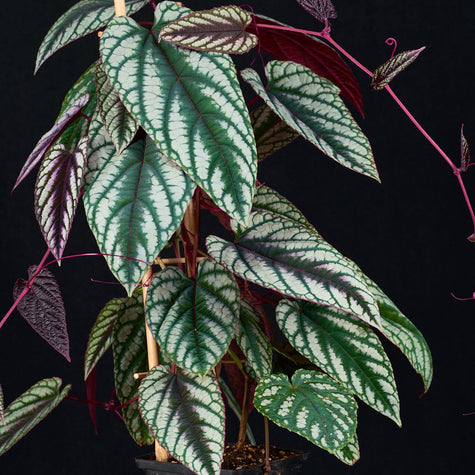
Phyllagathis rotundifolia, a Black Mouth Plant (Melastomataceae). My personal favorite! One of the largest of all iridescent plants. A single leaf can grow up to 50 cm long and wide! It also gets its blue coloration from iridoplasts, but also appears blue due to the strong sheen of its leaves, similar to the Piper further up in this post.
Anatomy and ultrastructure of the blue iridescent leaves of Phyllagathis rotundifolia. From Gould and Lee (1996), modified.
(7) Light microscopic images of cross-sections showing iridoplasts in the adaxial epidermis (arrowheads). Bar = 50 µm.
(8), (9) Electron microscopic images of sections through iridoplasts showing thylakoids. Bars = 0.5 µm and 0.25 µm, respectively.
Our knowledge of these structures is limited to relatively few studies on a small number of species, and it is entirely possible that further, novel mechanisms exist. In my collection are several plants whose method of producing iridescence has never been studied, and which exhibit properties suggesting that mechanisms other than those known are at work.
Conversely, there are also plants that possess these structures but have no visible iridescence. For example, quite a few plants have helical cellulose fibers like Danaea nodosa, but show no iridescence at all.
It also appears that all begonias form iridoplasts, even those that have no iridescence to the eye.
Begonia leaves of iridescent (B. pavonina) and non-iridescent (B. polygonoides) species, observed under the microscope with epi-illumination (left column) and confocal laser scanning microscope (CLSM) (right column).
Arrowheads show vivid colored iridoplasts as blue spots in the epidermal cells. Dashes mark the edges of individual epidermal cells, which show artificially blue-stained iridoplasts in the cells. Bars in stereomicroscopes = 100 μm. Bars in CLSM images = 10 μm.
From Phrathep (2020), modified.
5. Why?
In the examples, you can see how much effort these plants have to put in to produce these highly ordered structures. But why? This question remained unanswered for a long time, and is still controversial! The first thought would be that the color itself has a function. That wouldn't even be so unusual. Structural colors are widespread in nature.
In animals (just think of the splendid feathers of male peacocks or the blue wings of Morpho butterflies), they almost always serve to attract attention, for example, to attract mates. Almost every blue animal is blue not due to pigments, but due to structural color.
There are also examples of structural colors in plants that are meant to be conspicuous.
The common buttercups (Ranunculus spp.), for example, use interference on thin layers (the same mechanism as in Selaginella) to make their yellow flowers even yellower and more conspicuous.
There are also examples of plants that use blue iridescence to stand out. The fruits of some plant species use iridescence to produce a very striking blue color. The mechanism for this, in most examples studied so far, are helical cellulose fibers, as in Danaea nodosa.
The plants discussed in this article, however, do not have blue flowers or fruits, but leaves. For flowers and fruits, it makes sense for a plant to stand out; it wants to attract pollinators for its flowers, on the one hand, and dispersers for its fruits (or seeds), on the other. For leaves, however, it makes no sense to want to stand out. Rather, the opposite. No plant actually wants leaves that are conspicuous to herbivores!
For this reason, it is also assumed that the very striking blue coloration is an unintended side effect and that the actual function of the structures that cause this effect is different. And it must be a rather advantageous function to make the very striking coloration worthwhile!
What these blue plants (almost!) all have in common is their habitat: they grow in the very shady undergrowth of tropical rainforests.
There, very, very little light reaches. The tree crowns filter about 99.7% to 99.9% of the sunlight before it reaches the forest floor (Björkman and Ludlow, 1984). It has long been suspected that the light-interacting nanostructures in these undergrowth plants play some role in capturing or focusing this sparse light.
As early as 1984, Hébant and Lee showed that the structures, and thus the blue coloration in Selaginella uncinata , are only formed when it receives weak light, and this light corresponds to the spectrum of light on the forest floor (For experts: 12 μmol·m-2·s-1 with R:FR of 0.35).
It was also shown that the formation of these structures is possible in both directions (non-blue specimens become blue, and blue specimens lose their color), and is reversible in the same plant.
I have also observed this in many of my own plants: with strong light, the coloration disappears; with weak light and the correct spectrum, it reappears. The color change takes about two to four weeks. It is also possible to have both iridescent and non-iridescent leaves on the same plant, depending on how much light they receive. Even within a leaf, there can be differences!
It thus seems clear: these nanostructures help the plant in some way to cope with very little light.
How exactly these structures function and what their benefit is was only shown in 2016 by Jacobs et al. using the iridoplasts of some begonias.
According to the authors, these structures promote the efficiency of photosynthesis! They do this in two ways: firstly, by improved light capture in the predominantly green wavelengths available in the shade, and secondly, by directly increasing the quantum yield by 5-10% in low light.
Sounds absolutely crazy. And it is.
The iridoplasts with their regularly arranged membranes form a so-called photonic crystal. Photonic crystals can greatly enhance or reduce the absorption of light by greatly slowing down light of certain wavelengths (Yes, that's possible, the speed of light is only constant in a vacuum!) and concentrating it in standing waves .
This slowed-down light ("slow light") is practically "trapped" in the photonic crystal and concentrated and passed on to the chloroplasts. The thylakoid membranes in the iridoplasts are arranged at exactly the right distance to capture green and red light. Exactly what mainly arrives at the forest floor.
They also perform this capture from a relatively large angle of 30°, much larger than the 15° angle at which they reflect blue light. This seems to prove that blue iridescence, as suspected, is actually just a side effect.
Increased absorption in the green part of the spectrum serves to more effectively capture residual light on the forest floor. And yes, plants also use green light quite effectively for photosynthesis! It is a myth that green light is completely useless for photosynthesis.
Reflecting blue light is probably not a major disadvantage compared to stronger absorption of green and red, considering that blue wavelengths are only present in very small amounts on the forest floor anyway.
A very fascinating and initially convincing explanation for the beautiful appearance of our plants, but (and there's always a but) this study only examined the structures in begonias. Other plants, with other mechanisms that produce iridescence, were not examined. Perhaps these structures have the same function in these plants as the iridoplasts of begonias, but perhaps not.
Here are a few examples of plants that probably use a still unknown mechanism for iridescence and/or whose iridescence probably has a different function than the one described above:
Microsorum thailandicum
Microsorum thailandicum, a polypodiaceae fern and the plant in my collection with the absolute most intense blue hue, shows no angle dependency. The leaves are blue from every direction, and photographing them with a flash makes them appear less blue in the pictures.
It is doubtful whether the mechanism described above can be responsible for the blue color here.
Microsorum siamense
Microsorum siamense is not as intensely blue as its close relative above, but shows the same effect. Flashlight or a certain angle are not necessary for the iridescence to appear.
Another difference: in many iridescent plants (especially Selaginella), their shimmer partially or completely disappears when the leaves get wet. This is not the case with these ferns; the leaves are still blue even when moist.
Begonia sp. 'Temuyuk'
This as-yet-undescribed Begonia shows the same effect as the two Microsorum species. Its iridescence is very difficult to capture, as the leaves are highly glossy, which obscures the dark blue tone.
Just like with Microsorum, the color here is not dependent on angle and is not diminished by water on the leaves.
This is interesting in that the explanation mentioned above specifically referred to Begonias, but there appears to be at least one Begonia that uses a different mechanism to appear blue. Are differently designed iridoplasts responsible here, or an entirely different mechanism? And is it also blue to capture more light, or does its color have another function? We don't know.
Bulbophyllum cruzi
This miniature orchid from the large genus Bulbophyllum also exhibits a similar effect to Microsorum. The blue sheen can be seen from almost any angle and is not diminished by water on the leaves.
Masdevallia caesia
Masdevallia caesia, a highland orchid, produces a rather strong iridescence, but only in (relatively) intense light. In low light, it remains green!
Its iridescence is thus exactly contrary to what is found in shade plants, which lose their blue shimmer in strong light. The explanation that the blue hue is a side effect and that the nanostructures that produce it serve to capture faint residual light cannot be correct here either.
One possible explanation is that the reflection of blue light is actually the primary function here, serving as protection against overly intense radiation.
Absurdly, its iridescence is more pronounced when the leaves are wet.
Stegolepis hitchcockii
Stegolepis hitchcockii, a plant closely related to grasses, grows only on Brazil's highest mountain, Pico da Neblina, in absolutely intense, radiant light…and yet has very strong blue iridescence.
It might use its shimmer similarly to M. caesia, as sun protection.
Well, that's enough examples for now of plants that may use other mechanisms for iridescence, or that use their iridescence differently than previously known.
It is, of course, undisputed that many plants, especially Begonias, use their iridoplasts to capture more light as shade plants. The other structures shown in various species, which make these shade plants appear blue, most likely have a similar or even the same function as in the Begonias studied by Jacobs et al.
However, as we have just seen, there appear to be several other mechanisms in plants for producing iridescence. These, however, seem to function differently at the nano-level than the known examples. At least in Microsorum thailandicum, it is known that a known structure, namely helical cellulose, is responsible for the very intense blue color (Steiner et al. 2018).
What we have also seen is that iridescence most likely does not have the same function in all plants. In some examples, the blue reflective coloration itself appears to be the function, and not just an unintentional side effect. Here, the blue sheen may serve as sun protection in habitats with intense light.
Another possible function of iridescence is to confuse herbivores. It has been shown that bumblebees have difficulty recognizing highly iridescent objects. Iridescence could therefore have a protective effect. To the human eye, the blue coloration is, of course, very striking (which is why I collect these plants!), but for the often completely differently structured visual systems of other animals, these plants could look very different than they do to us!
One should also not forget that it is entirely possible for iridescence to fulfill several functions simultaneously. Even seemingly contradictory functions, such as capturing faint green light in deep shade and reflecting blue light in dazzling sunlight, could be advantageous in one and the same plant.
This is at least what Glover and Whitney (2010) suspect. They argue that plants adapted to low light conditions could be damaged in a very short time by sunflecks shining through the canopy. This conjecture was made before it was known that at least some Begonias have a function for capturing extra light, but it still makes perfect sense. These inconspicuous spots are 100 to 10,000 times brighter than what these shade plants are normally exposed to and what they are adapted to. So it could well be that the iridescence in the same plant both protects against too much sun and helps in low sun (or rather, the nanostructures help; in low light, the sheen is just a side effect).
Steiner et al. speculate that the blue sheen of Microsorum thailandicum fulfills this dual function, and Phrathep (2020) suggests that this could also apply to Begonias.
As is often the case in biology, it will most likely turn out that there is no single explanation, but many reasons and many mechanisms behind the phenomenon of iridescent leaves. There are still more than enough unanswered questions here, and certainly many exciting details to keep research busy for many years to come.
If this blog has now sparked your interest, or even enthusiasm, for this truly great and diverse group of plants: Feel free to visit our shop .
We regularly offer various iridescent plants and are constantly expanding our range. With over 30 species (not all of which are in the shop yet), we already have probably the largest selection of shimmering botanical beauties in all of Europe!

(1) Begonia metallicolor
All images in this post, unless otherwise stated, as well as post text: © Alexander Ruppert