

In the last blog post about the lighting of houseplants , we covered the needs of plants in terms of light quality and quantity and explained all the necessary terminology. If you're still confused about Lux, yMol/s, or light spectra, you can read up on the relevant information there.
However, since there is often confusion about what good grow light setups can be in practical scenarios, some examples will follow here.
Most people will fall into one of the 3 following situations for which a suitable plant lamp is sought:
- Houseplants at a short distance ~20-80 cm, e.g., in a plant display case or terrarium plants
- Houseplants at a greater distance >80-200 cm or tall terrariums
- High-light plants such as cannabis at short-to-medium distances or in grow tents
Table 1: Overview of exemplary uses for Jungle Lux models
| Jungle Lux | Light requirement | ~ Distance | Applications |
| Linear Basic | Low | 15-80 cm | Shelf and display case lighting, terrariums |
| Linear Plus | Medium-High | 20-100 cm | Larger terrariums, grow tents (cannabis etc.), greenhouse |
| Linear Lens | Medium | 30-150 cm | Tall terrariums, open plant areas |
| Spot 12W | Medium | 30-150 cm | Tall terrariums, open plant areas |
| Spot 20W | Medium-High | 50-250 cm | Tall terrariums, plants further away, accent lighting |
| Highlight | High | 30-150 cm | Grow tents (cannabis etc.), open plant areas, greenhouse |
| Stand | Variable | 10-50 cm | Bottle garden |
| Mini | Low | 5-50 cm | Narrow shelves, mini terrariums |
| Linear UV | UV only | 30-100 cm | Crops, reptiles |
The following Lux and PAR values were determined in a darkened room without reflective film, always centrally under the lamp, using a calibrated ITC parameter. Values from a smartphone-quality lux meter usually cannot be compared; in many cases (for Android), the values from the graph must be approximately doubled.
Note the significantly higher brightness values of the focused versions; this always comes with a smaller irradiated area. The brightness decreases from the inside out within the irradiated area.
Specifically, the width of the irradiated area at a distance of 0.5 m is:
120° –> 1.7 m
60° –> 0.6 m
40° –> 0.36 m
30° –> 0.27 m
This applies to punctual light sources; for linear luminaires, the length of the luminaire must be added.
So, for example, Linear Lens 60 –> 0.6 m width x 1.2 m length of irradiated area.
For other values, you can use the following calculator: Beam Angle Calculator


Fig. 1: Comparison of the brightness values of the Jungle Lux lamps by distance from the lamp, including a comparison with Sansi 24W Spot
1. Houseplants at a short distance ~20-80 cm
e.g., in a plant display case or terrarium plants
Here, in most cases, the light intensity should not be too high, but very well distributed over a short distance. Linear lamps with a standard 120° beam angle are suitable for this. This way, even at a short distance of approx. 10 cm, you don't have to worry about burns or yellow leaves.
For 35-50 cm width: Jungle Lux Linear 40
For 55-70 cm width: Jungle Lux Linear 60
For 75-90 cm width: Jungle Lux Linear 80
For 95-120 cm width: Jungle Lux Linear 100
This results in, for example, approx. 3500 Lux at 30 cm below the lamp.
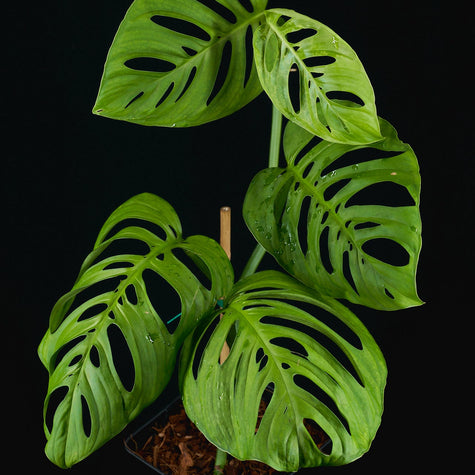
Typically, one lamp is installed per shelf at a depth of up to approx. 40/50 cm, and two for deeper dimensions. This results in moderate light intensities, ideal for, e.g., Alocasia, Monstera, Calathea, Begonia or other mixed plantings. The same applies to shallow terrariums up to approx. 40/50 cm high.
For more light with a very wide beam, linear luminaires with higher power are suitable. Ideal for larger terrariums, grow tents or light-hungry plants such as Nepenthes, bromeliads or Cannabis cultivation.
For 35-50 cm width: Jungle Lux Plus 40
For 55-70 cm width: Jungle Lux Linear Plus 60
For 75-90 cm width: Jungle Lux Linear Plus 80
For 95-120 cm width: Jungle Lux Linear Plus 100
This results in, for example, approx. 7000 Lux at 30 cm below the lamp.
However, the light diminishes very quickly over larger distances, and at about 80 cm from the leaf, the lux density is already very low. For taller terrariums, these are best used in combination with Spots or the Linear Lens.
2. Houseplants at a greater distance >80-200 cm or tall terrariums
At greater distances, lenses in the lamp are a must. These focus the light, which would otherwise scatter from the LEDs, in the desired direction. This saves electricity more easily than compensating for insufficient light intensity with more power, and it looks better (also less dazzling).
The power and design must be selected according to the needs. For smaller applications, spots with E27 screw bases are already suitable.
For ~50-150 cm distance: Jungle Lux Spot 12W
For ~80-200 cm distance: Jungle Lux Spot 20W
This results in, for example, approx. 9000 Lux at 50 cm below the lamp (12W) or at 90 cm (20W)
For taller terrariums in combination with linear basic lighting, this is a really nice solution. It is also a good solution for illuminating isolated plants or small groups of freestanding plants. If you use these lamps with only small distances to the plant, you can also attract really light-hungry plants with little wattage. However, the irradiated area is rather small.
A new development is the linear spots, which with a 60° beam angle efficiently cover a wider area over a greater distance than regular luminaires. Ideal for taller terrariums from 60 cm, plant benches, or freestanding plant areas. This also casts a more natural shadow and is less dazzling.
For 35-50 cm width: Jungle Lux Lens 40
For 55-70 cm width: Jungle Lux Linear Lens 60
For 75-90 cm width: Jungle Lux Linear Lens 80
For 95-120 cm width: Jungle Lux Linear Lens 100
This results in, for example, approx. 6500 Lux at 50 cm below the lamp.
Focused at a medium 60°, the powerful Jungle Lux Highlight are designed for higher light requirements or larger areas. These luminaires can cover a medium to large distance depending on their power, or provide very high light intensities. When used with the 90°/120° interchangeable lenses, they can also be used as powerful floodlights at shorter distances. 
3. High-light plants such as cannabis at short-to-medium distances or in a grow tent
Anyone growing highly light-demanding plants such as cannabis, Nepenthes, or other crops needs a lot of power to achieve the appropriate intensities. Even with high-efficiency lamps like Jungle Lux, in the case of cannabis, this still means at least approx. 80-100W per square meter of plant surface during cultivation and more than double that during the vegetative phase. Therefore, it makes sense to use the strongest possible lamps from the outset. More light means a higher yield, but a significant harvest can also be achieved with less light. With too little light, plants become elongated and spindly.
The minimum requirement for cultivation is assumed to be 200 μmol/s*m2, and for continuous cultivation 500 μmol/s*m2, with a maximum value of 1000 μmol/s*m2.
Both the minimum and maximum recommended lighting are given as solution examples.
|
Example for a 40-size grow tent for one plant: Dimensions: 40cm x 40cm = 0.16 m2 Cultivation: 200 μmol/s*m2 * 0.16 m2 = 32 μmol/s Vegetation/Flowering: 500 μmol/s*m2 * 0.16 m2 = 80 μmol/s |
Solution 1: Jungle Lux Highlight 50W 100 μmol/s Solution 2: Jungle Lux Highlight 80W 160 μmol/s (Possibly also the 30W version for economical growers) |
|
Example for a 60 grow tent for 1-3 plants: Dimensions: 60cm x 60cm = 0.36 m2 Seedlings: 200 μmol/s*m2 * 0.36 m2 = 72 μmol/s Vegetation/Flowering: 500 μmol/s*m2 * 0.36 m2 = 180 μmol/s |
Solution 1: 1-2x Jungle Lux Highlight 80W 160 μmol/s Solution 2: 1-2x Jungle Lux Highlight 50W 100 μmol/s (With less utilization) Solution 3: 4-8x Jungle Lux Linear Plus 60 cm 40 μmol/s |
|
Example for an 80 grow tent for 1-3 plants: Dimensions: 80cm x 80cm = 0.64 m2 Seedlings: 200 μmol/s*m2 * 0.64 m2 = 128 μmol/s Vegetation/Flowering: 500 μmol/s*m2 * 0.64 m2 = 320 μmol/s |
Solution 1: 2-4x Jungle Lux Highlight 80W 160 μmol/s Solution 2: 2-4x Jungle Lux Linear Plus 80 cm 55 μmol/s + 1-2x Jungle Lux Highlight 80W 160 μmol/s Solution 3: 5-10x Jungle Lux Linear Plus 80 cm 55 μmol/s |