



Jungle Lux Spot - 12W E27 Plant Lamp 1600 Lumens
 Jungle Lux Spot - 12W E27 Plant Lamp 1600 Lumens
24,99€ EUR
/
Jungle Lux Spot - 12W E27 Plant Lamp 1600 Lumens
24,99€ EUR
/

products.product.pickup_availability.unavailable
Description
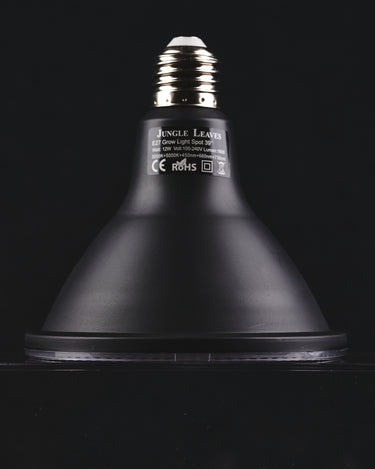
This full-spectrum grow light not only has a spot shape but also actually bundles the emitted light using a built-in lens. Beam angle approx. 38°.
By using Samsung LM301H horticulture chips, we achieve an efficiency of 140 lumens per watt of energy consumption, which is a worldwide first for an E27 spot. This already includes the integrated power supply and the red components. This corresponds to 170% of the light output of conventional diodes, including power supply and red components! (Comparison with a 10W spot from another manufacturer, approx. 900 lumens, i.e. 90 lm/W). The PPE value of the system is 2 μmol/s/W. With a power consumption of only 12W, a luminous flux of 1600 lumens is achieved.
You can read about which grow light is suitable for which application in our comparative blog.
Another advantage of the high efficiency is the low waste heat, which is quickly dissipated via the powder-coated aluminum housing. This results in a significantly longer service life than with lamps operating at high temperatures. The grow light can also be safely placed directly on glass panes (e.g. on a terrarium). The base of the lamp is flat to allow exactly this!
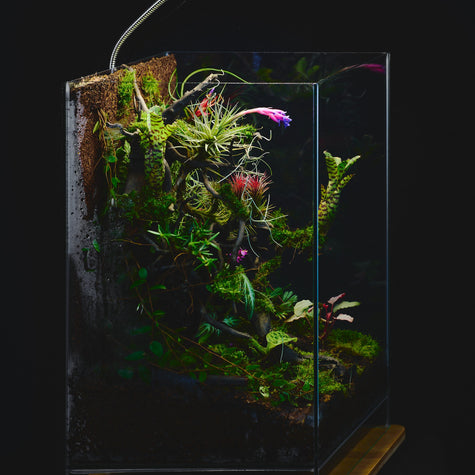
The focused light of this spot has a greater depth effect than, for example, linear lights like our Jungle Lux Linear. Therefore, the spot should also have a slightly higher minimum distance to sensitive plants. Taller terrariums/paludariums, plant display cases or free-standing plants can be ideally illuminated with it.
By combining 5000K (cool white) diodes with a new 430 nm chip, 3000K (warm white) diodes with a classic 450 nm chip and 660nm (red) diodes, the result is not only an optimal spectrum for plant growth, but also a pleasant, neutral white light color with very high color rendering (CRI ~90). Due to the flattened plateau in the blue range (double-peak), this radiation is better plant-available at the same intensity and colors appear more natural. It can also be combined very well with our equally neutral white Jungle Lux Linear tube-shaped plant lamps.
In addition to these diodes, which emit visible light, so-called "Far Red" infrared diodes with 730nm are also installed (absolutely unique in this price segment!). These produce light in the so-called near-infrared spectrum, which is invisible to humans but stimulates important physiological processes in plants. Especially for the often beautifully patterned plants of the undergrowth, these wavelengths are important for leaf coloration.
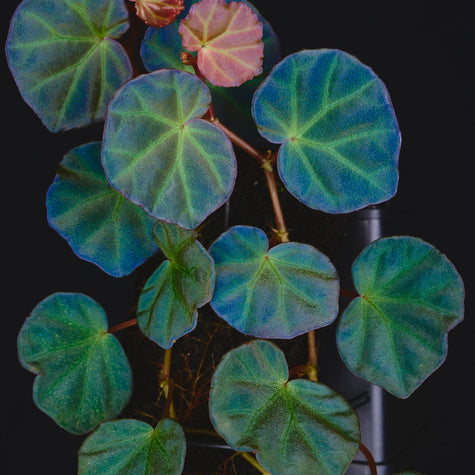
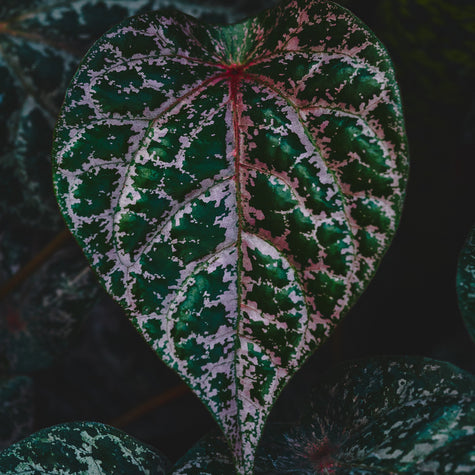
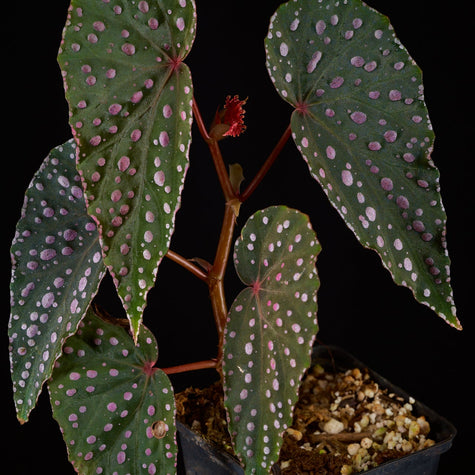
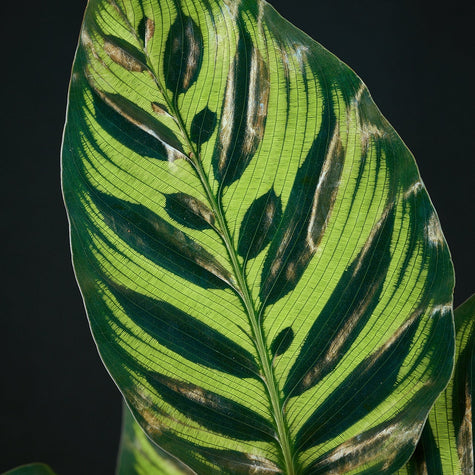
Plants perceive light via the so-called phytochrome system. Light in the "Far Red" range is the signal for the development of the special coloration that many shade-adapted plants can form, because exactly these wavelengths reach them under the dense canopy of the rainforest. Examples include the patterning in Calathea, the coloration of shade-loving Begonias and Selaginella and (especially interesting for us!) the blue iridescence of many shade plants! Here is a paper that specifically investigates what triggers the blue coloration in Selaginella uncinata. The result: The ratio of red (660nm) to Far Red light. Based on this data, our spots are adapted to provide a spectrum that is as close to nature as possible, leading to the best growth for undergrowth plants. "Normal" plant lamps do not include these wavelengths, as they do not play a significant role in, for example, flower formation and fruit ripening.
If you want to learn more about the correct lighting of houseplants, you can read our detailed blog on the subject.
Only the bulb (E27 thread) is supplied. Fittings and lampshades are now available!
Technical Data
Changelog
Product Safety Information


About Jungle Leaves
Bring The Tropics To Your Home
We are a modern nursery in the heart of the Ruhr area, with a
selection of extraordinary plants, ranging from simple houseplants
to genuine botanical rarities.
We have something for everyone interested in tropical plants,
and we place great importance on accurate information and
good, individual advice.